 |


| Quantity: | |
|---|---|
Product Details
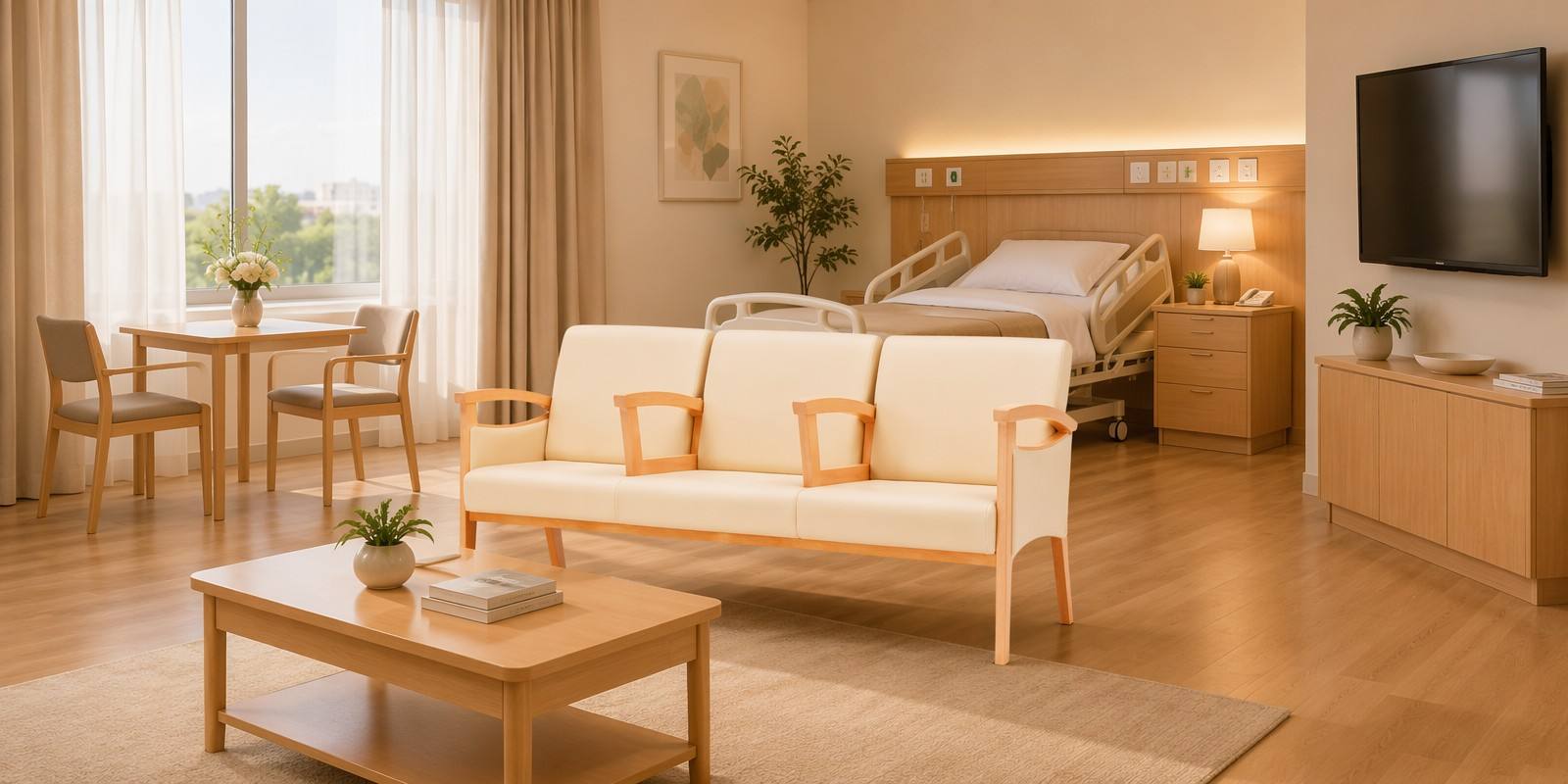
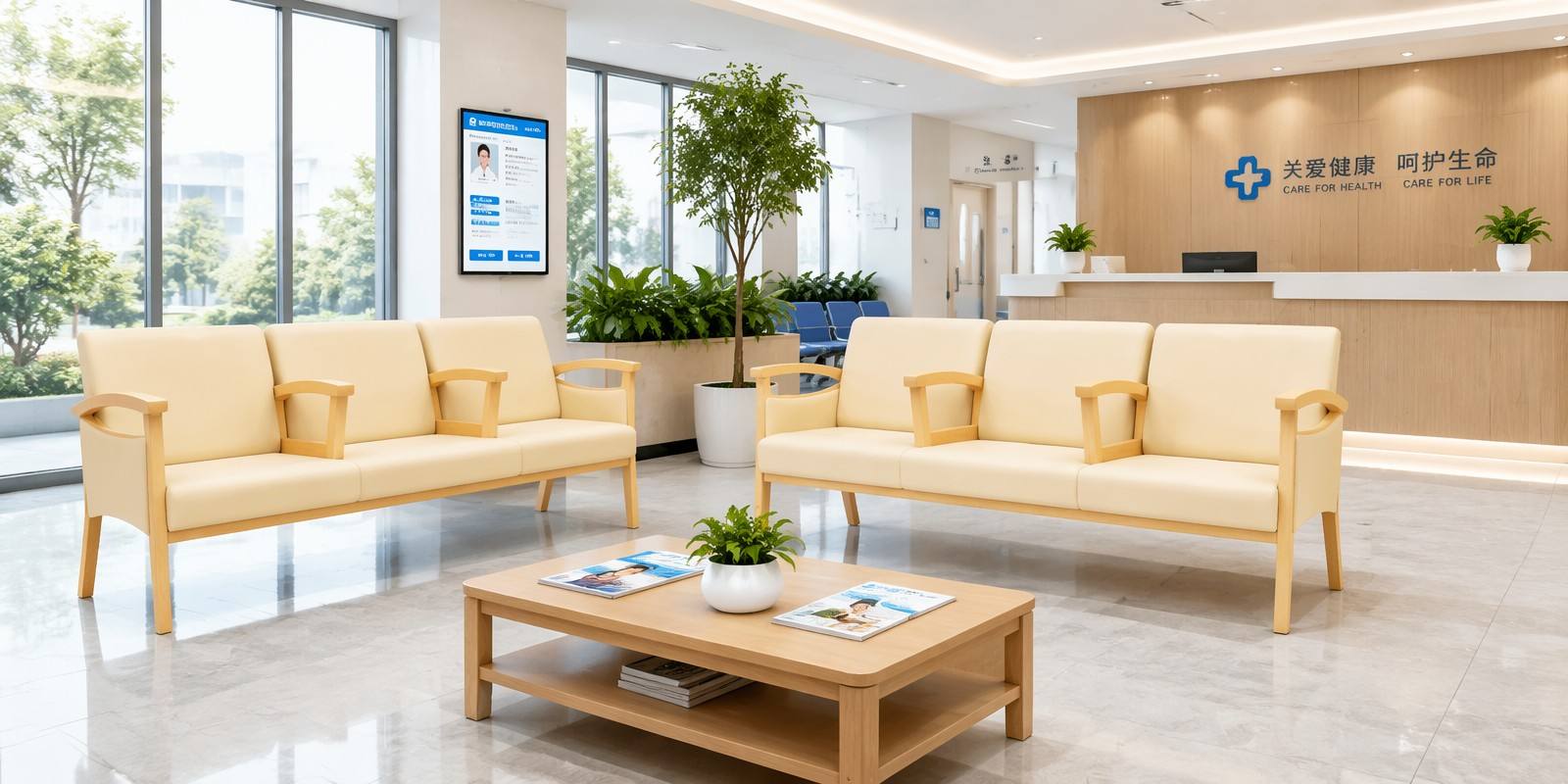
Engineered for the dual demands of healthcare: patient comfort and clinical-grade cleanability. The 3-seat configuration with built-in armrest dividers eliminates the territorial awkwardness of shared benches — each person gets their own clearly bounded seat. The outer armrests curve upward for easy grip during sit-to-stand transitions, a critical ergonomic feature for elderly and mobility-impaired users. The angled rear legs and low center of gravity provide anti-tip stability in high-traffic waiting areas, while the seamless faux leather surface can be wiped down in seconds between patients using standard hospital disinfectants.
Attribute Table
Attribute Specification
Model HY-MWS-3S
Product Type 3-Seater Medical Waiting Sofa / Healthcare Lounge Seating
Overall Dimensions (L×W×H) 2100 × 680 × 820 mm (customizable)
Seat Height 450 mm
Seat Depth 500 mm
Backrest Height 370 mm
Single Seat Width 580 mm (per seat bay)
Armrest Height 640 mm
Frame Material Solid Maple Wood, E1-Grade
Frame Finish Satin Water-Based Lacquer (Natural Grain)
Upholstery Material Medical-Grade PU Faux Leather, 1.2mm Thickness
Upholstery Color Pale Cream / Off-White (custom colors available)
Cushion Core High-Density PU Foam (45D seat / 38D back)
Armrest Type 2 Outer Curve + 2 Inner Island Divider Armrests
Weight Capacity 450 kg total (150 kg per seat)
Net Weight 52 kg
Packing Knock-Down (KD) Flat-Pack, 1 unit/carton
Installation Assembly Required, Tools & Manual Included
MOQ 5 Units
Delivery Time 25–35 Days (FOB)
Certification ISO 9001, CE, ANSI/BIFMA, CAL 117 (Flammability)
Warranty 5-Year Frame / 2-Year Upholstery
Customization Size, Wood Species, Leather Color, Metal Leg Option, 2-Seater Variant
┌──────────────────────────────────────────────────────┐
│ 2100 mm │
│ ┌────┬──────────────────────────┬────────────────┐ │
│ │ │ 3 Back Cushions │ │ │
│ │ O │ ┌──────┐ ┌──────┐ ┌──┐ │ O │ │
│ │ u │ │ L │ │ C │ │R │ │ u │ │
│ │ t │ └──────┘ └──────┘ └──┘ │ t │ │
│ │ e │─────────────────────────│ e │ │
│ │ r │ Seat Cushion │ r │ │
│ 820 A │ ┌──────┬──────┬──────┤ A │ mm
│ mm r │ │Seat 1│Seat 2│Seat 3│ r │
│ │ m │ │580mm │580mm │580mm │ m │
│ │ │ ├──────┼──────┼──────┤ │ │
│ │ │ │ Inner│ Inner│ │ │ │
│ │ │ │Armrest│Armrest│ │ │ │
│ └─────┴──┴──────┴──────┴──────┴──────────────┘ │
│ ◄── 680 mm ──► │
└──────────────────────────────────────────────────────┘
▲ Front Legs (tapered square) ▲ Rear Legs (angled)
Materials
Component Material Description
Frame & Rails Solid Maple Wood, E1-Grade North American maple; dense grain structure resists dents and scratches in high-traffic use
Outer Armrests Solid Maple Wood (Curved Profile) Ergonomic 38 mm diameter grip curve; sanded to 400-grit smoothness for patient comfort
Inner Dividers Solid Maple Wood (Open-Frame Loop) Rectangular loop design provides arm support without visual mass; allows seat belt access if needed
Legs Solid Maple Wood (Tapered / Angled) Front: square tapered; Rear: 5° outward angle for anti-tip stability under forward-leaning load
Seat Cushion High-Density PU Foam (45D) + PU Leather 100 mm thickness; tested to 120,000 compression cycles with <8% thickness loss
Back Cushions Medium-Density PU Foam (38D) + PU Leather 3 independent cushions with hook-and-loop attachment; individually replaceable
Upholstery Surface Medical-Grade PU Faux Leather, 1.2 mm Fluid-proof, anti-microbial treatment, UV-stable; withstands 10,000+ disinfectant wipe cycles
Base Rail Solid Maple Wood (Horizontal) Continuous front rail conceals frame joinery; protects flooring from leg pressure points
Hardware Stainless Steel M8 Bolts + Threaded Inserts Pre-installed factory inserts prevent wood stripping during assembly; corrosion-resistant
Finish Water-Based Satin Lacquer Non-toxic, low-VOC; scratch-resistant satin sheen; retains natural maple grain clarity
Features
4-Armrest Configuration with Island Dividers — Outer curved armrests aid sit-to-stand transitions; inner island dividers give each of 3 users a clearly defined personal space, reducing patient anxiety in shared waiting environments.
Medical-Grade PU Leather Surface — Seamless, non-porous faux leather prevents fluid ingress; compatible with 70% isopropyl alcohol, quaternary ammonium, and diluted bleach wipes. No staining, no cracking after accelerated aging tests.
Angled Rear Leg Anti-Tip Design — Rear legs angled 5° outward, lowering the center of gravity and resisting forward tip-over — critical for facilities serving elderly or bariatric patients who lean heavily on armrests when rising.
3 Independent Back Cushions — Each back cushion is separately mounted with hook-and-loop fasteners. If one section is damaged, replace only that cushion — no need to reupholster the entire sofa.
Knock-Down (KD) Flat-Pack — Ships disassembled for 45% freight cost reduction vs. fully assembled; assembly under 20 minutes with pre-installed threaded inserts and included tools.
Ganged Seating Ready — Multiple units can be placed side-by-side to create continuous row seating for large waiting halls; consistent height and armrest alignment across units.
Product Advantage (5 Concise Selling Points)
Disinfection Without Degradation — The 1.2 mm medical-grade PU leather has been cycle-tested against hospital-grade disinfectants: zero surface peeling, zero color fading, zero chemical odor retention after 10,000+ wipe-downs. Standard commercial upholstery fails this within months.
Dignity by Design — The island armrest dividers are not decorative. They give elderly patients, those with mobility aids, and immunocompromised individuals a clearly bounded personal zone — reducing cross-patient contact anxiety and territorial tension in crowded waiting rooms.
Anti-Tip Engineered for Geriatric Use — The 5° rear leg angle is a structural safety feature, not a style choice. When a patient pushes down on the armrest to stand — exerting up to 80% of body weight forward — the sofa stays planted. Standard vertical-leg sofas tip.
One Cushion Fails, Not the Whole Sofa — 3 independently replaceable back cushions mean one damaged section doesn't sideline a $1,200 seating unit for days. Maintenance staff swaps a cushion in 30 seconds — no tools, no upholstery skills, no downtime.
Project-Ready Consistency — Order matching 2-seater variants, corridor benches, bedside cabinets, and overbed tables from the same maple series. One wood species, one finish code, one color-match across your entire facility — no patchwork sourcing.
Solution to the Pain Point
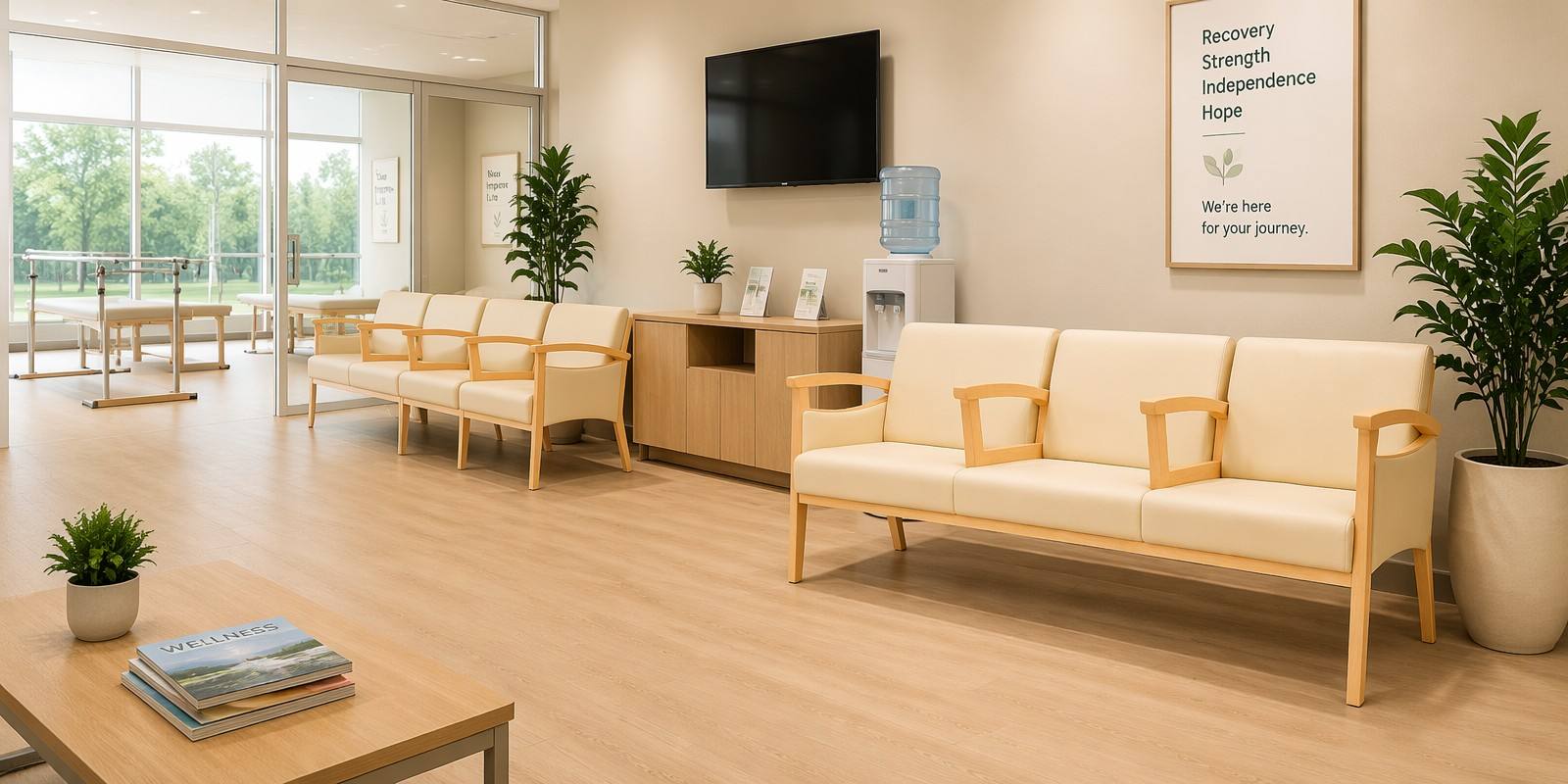
Healthcare facility purchasing managers face an impossible brief: seating must look warm enough to calm anxious patients, yet withstand the most aggressive cleaning protocols in any commercial environment. Standard residential-style sofas fail under hospital disinfectants — PU leather delaminates, fabric absorbs fluids, wood finishes cloud and peel. Meanwhile, all-metal or all-plastic institutional seating feels cold and punitive, undermining patient satisfaction scores and the healing environment.
This 3-seater medical sofa bridges that gap at the material level. The 1.2 mm PU leather is a monolithic, non-porous surface — there are no stitch holes, no fabric weave, no substrate for pathogen colonization. A 30-second wipe-down with standard hospital disinfectant leaves it clinically clean with no surface degradation. The solid maple frame, sealed with satin water-based lacquer, resists the same chemicals without clouding or peeling — maintaining the warm, residential aesthetic that reduces patient cortisol levels in waiting environments. The island armrests serve a dual clinical function: physical separation between patients (infection control) and psychological comfort (personal space in an inherently stressful setting). The result is seating that meets the Infection Control committee's standards and the Patient Experience team's expectations in a single SKU.
Design Philosophy
"Privacy Within Proximity."
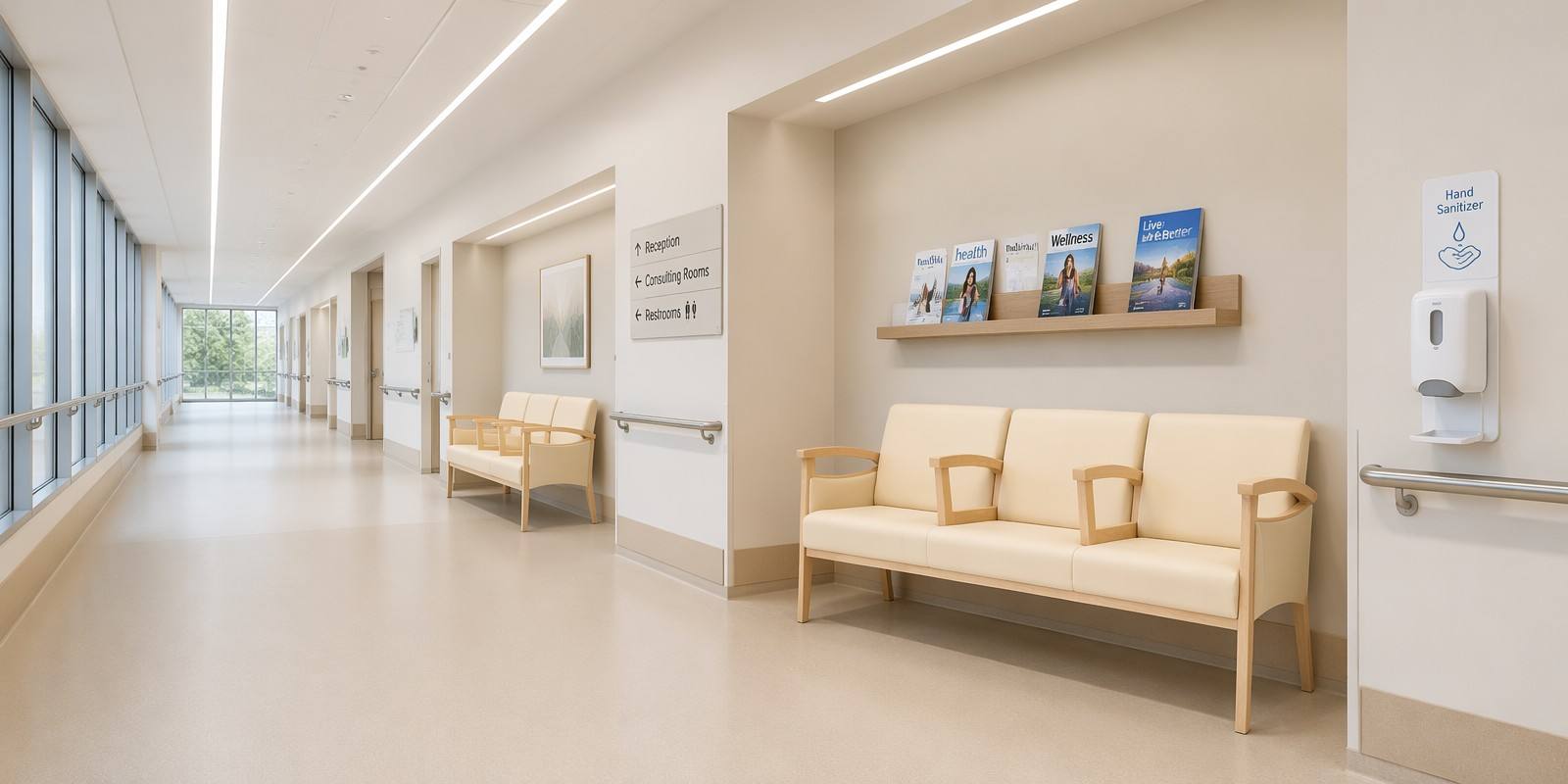
Shared waiting areas in healthcare are paradoxical spaces: patients must sit close together, yet every individual craves distance. The 4-armrest configuration — two outer curves for entry/exit support, two inner island dividers for personal boundary — resolves this tension without adding walls or partitions. Each seated person occupies a visually and physically defined bay, even while sitting shoulder-to-shoulder.
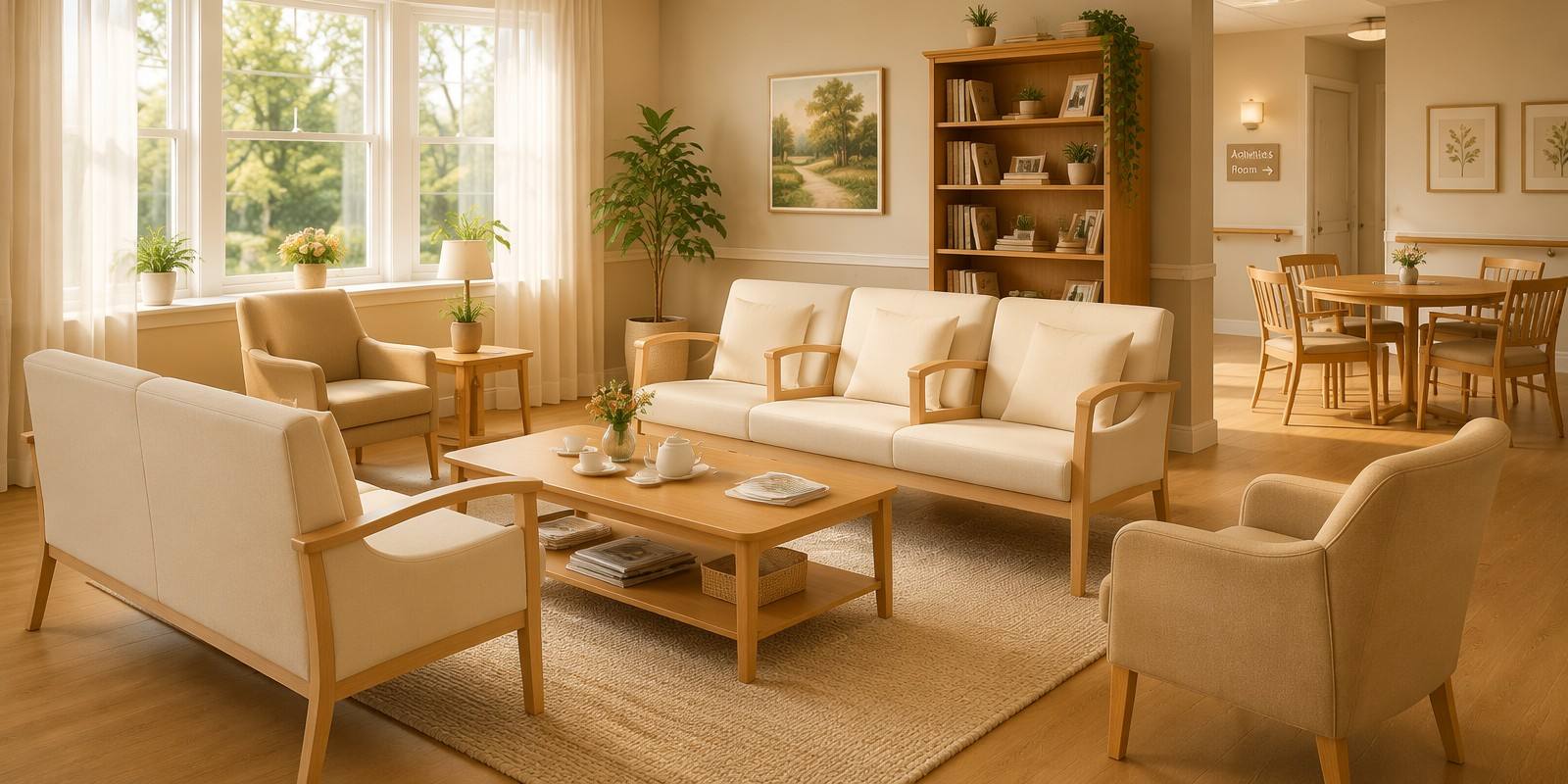
The material palette follows biophilic design principles adapted for clinical environments. Natural maple — a warm, light-toned hardwood with subtle grain — replaces the chrome and injection-molded plastic that dominate medical furniture. It signals "care" rather than "containment." The pale cream upholstery was chosen for its clinical readability: stains, fluids, and contamination are immediately visible to cleaning staff, unlike dark fabrics that hide hazards. The satin lacquer finish reflects just enough light to feel clean without the institutional gloss of high-sheen polyurethane.
Every curve — the outer armrest arc, the back cushion corner radius, the inner divider loop — is intentionally soft. No sharp edges. No right angles at contact points. This is furniture designed for bodies that are fragile, for hands that grip tightly, for moments of vulnerability.
Design Details
Detail Description
Outer Armrest Arc 38 mm diameter continuous curve from backrest rail to front frame corner; 640 mm apex height matches average adult elbow height for natural arm placement during sit-to-stand
Inner Divider Dimensions 120 mm (W) × 350 mm (H) open-frame loop; 15 mm thickness; gap at bottom allows cleaning access and prevents debris accumulation
Seat Bay Width 580 mm per seat — exceeds ADA-recommended 450 mm minimum; accommodates winter coats, handbags, and medical devices without encroaching on adjacent seats
Backrest Angle 10° recline from vertical; passive support without encouraging deep slouching; tested to maintain head-neck alignment during 45-minute average clinic waiting times
Cushion Attachment Industrial-grade hook-and-loop strips (50 mm wide, full-length); holds cushions flush against frame during lateral patient movement while allowing tool-free removal
Front Rail Clearance 25 mm gap between floor and front rail underside; allows mop access and airflow; prevents moisture wicking into wood
Corner Radius 12 mm minimum radius on all wood corners; exceeds European healthcare furniture safety standard EN 16139 Level 2
Hardware Concealment All bolt heads recessed 3 mm below wood surface and capped with matching maple plugs; no exposed metal within patient contact zones
Leg Foot Pads 4 mm thick clear thermoplastic elastomer (TPE) pads on all leg bottoms; non-marking, non-slip, replaceable without disassembly
KD Joint Design Cam-lock + dowel system at all major frame connections; factory pre-installed metal cam posts prevent wood thread wear across multiple assembly/disassembly cycles
Delivery & Returns
FOB Port: Shenzhen / Guangzhou / Shanghai (customer nominated)
Lead Time: 25–35 days for standard orders; 45–60 days for custom configurations
Packaging: KD flat-pack in 7-layer corrugated master carton with molded EPE foam end-caps; 1 unit per carton
Carton Dimensions: 2150 × 720 × 280 mm, 58 kg gross
Container Loading: 40HQ fits approximately 90 units (KD); 20GP fits approximately 40 units (KD)
Shipping Terms: FOB / CIF / DDP available; customer-assigned forwarders accepted
Sample Lead Time: 7–10 days for stock finish; 15–20 days for custom leather color
Sample Shipping: DHL / FedEx / UPS; sample cost deducted from first bulk order
Returns
Manufacturing defect claims must be submitted within 14 days of delivery with dated photographic evidence
Custom-sized, custom-finished, or custom-upholstery-color orders are non-returnable and non-refundable
Return shipping at buyer's expense unless product is confirmed defective by our QC team
Replacement parts or full-unit replacement shipped free of charge for verified warranty claims
Refunds processed within 10 business days of returned goods receipt and inspection
Warranty
Coverage Duration Scope
Solid Maple Wood Frame 5 Years Structural integrity, joint separation, warping, cracking under normal institutional use
PU Leather Upholstery 2 Years Delamination, peeling, cracking, seam separation, color fading beyond 3 Delta-E units
Cushion Foam Core 2 Years Thickness loss exceeding 15% of original; permanent compression set visible when unoccupied
Hardware & Fasteners 5 Years Corrosion, thread failure, cam-lock mechanism failure under normal assembly torque
Surface Finish 2 Years Peeling, blistering, clouding, or significant discoloration under standard healthcare cleaning protocols
Leg Foot Pads 1 Year Wear-through, detachment, or material degradation under normal floor-contact use
Exclusions: Damage from misuse, abuse, unauthorized structural modification, use of non-approved abrasive or solvent-based cleaners, outdoor exposure, or failure to follow assembly instructions. Warranty void if weight capacity is exceeded.
FAQ
Q: Can this sofa be ordered in a 2-seater version? A: Yes. The 2-seater variant (HY-MWS-2S) measures 1520 × 680 × 820 mm with one inner island divider between two seats. All materials, finishes, and certifications are identical. MOQ for mixed 2-seater and 3-seater orders is 10 units total.
Q: What leather colors are available beyond pale cream? A: Our medical-grade PU leather library includes 40+ colors: warm gray, taupe, navy, forest green, burgundy, charcoal, and more. Custom Pantone-matched colors available for orders of 50+ units. All colors carry the same disinfection-resistance certification.
Q: How do I clean and disinfect this sofa between patients? A: Spray or damp-wipe with 70% isopropyl alcohol, quaternary ammonium disinfectant, or 1:10 diluted sodium hypochlorite. Wipe dry with a clean microfiber cloth. The seamless PU leather surface has no stitching — fluids cannot penetrate. Do not use abrasive pads, acetone, or undiluted bleach.
Q: Is the sofa suitable for bariatric patients? A: The standard model is rated to 150 kg per seat (450 kg total). For bariatric requirements, we offer a reinforced variant (HY-MWS-3S-B) with steel internal frame bracing and upgraded 55D foam, rated to 250 kg per seat. Externally identical to the standard model.
Q: Can the sofa be fixed to the floor? A: Yes. Each leg base has a pre-drilled anchor point accessible by removing the TPE foot pad. M8 expansion anchor hardware included for concrete substrates. For raised-access flooring or timber subfloors, mounting brackets available upon request.
Q: Is the PU leather fire-rated for healthcare facilities? A: Yes. The upholstery meets California Technical Bulletin CAL 117-2013 (Section E) flammability standards. BS 5852 (UK) and EN 1021-1/2 (EU) test reports available upon request. Full CAL 133 (high-hazard) compliance can be specified for behavioral health units at a surcharge.
Q: What other furniture do you manufacture in the same maple series? A: The Hongye MedCare maple series includes: 2-seater waiting sofas, 4-seater corridor benches, hospital beds with matching headboards, bedside cabinets, overbed tables, visitor chairs, doctor consultation desks, and senior living dining sets. All share the same maple species, satin lacquer finish, and cream PU leather — ensuring visual consistency across your entire facility. A project catalog with SKU matrix is available on request.
Q: What is the expected service life of this sofa in a busy hospital waiting area? A: With standard daily cleaning and disinfection protocols, the frame is rated for 8–10 years of continuous institutional use. The PU leather is rated for 5–7 years before cosmetic replacement is recommended. Individual cushion replacements can extend the aesthetic service life to match the frame warranty period.
Q: Do you offer on-site assembly for large projects? A: For orders of 50+ units, we provide a factory-trained installation supervisor at no additional charge (buyer covers travel and accommodation). Detailed illustrated assembly manuals and QR-coded video instructions are included with every unit for self-assembly. Average assembly time: 15–20 minutes per sofa with 2 personnel.