| Availability: | |
|---|---|
| Quantity: | |

| Attribute | Specification |
|---|---|
| Model | HY-MWL-2S |
| Product Type | 2-Seater Medical Loveseat / Healthcare Visitor Sofa |
| Overall Dimensions (L×W×H) | 1500 × 720 × 830 mm (customizable) |
| Seat Height | 450 mm |
| Seat Depth | 520 mm |
| Backrest Height | 380 mm |
| Armrest Height | 640 mm (apex of curve) |
| Frame Material | Solid Oak / Walnut-Stained Hardwood, E1-Grade |
| Frame Finish | Satin Lacquer (Dark Brown, Natural Grain) |
| Upholstery Material | 100% Polyester, 350g/m², Tight-Weave Canvas |
| Upholstery Color | Apricot Orange (custom colors available) |
| Cushion Core | High-Density PU Foam (45D seat / 38D back) |
| Backrest Structure | 2-Section with Inset Structural Seam |
| Armrest Design | Sculpted Curvilinear — Backrest-to-Front-Joint Flow |
| Weight Capacity | 300 kg total (150 kg per seat) |
| Net Weight | 35 kg |
| Packing | Knock-Down (KD) Flat-Pack, 1 unit/carton |
| Installation | Assembly Required, Tools & Manual Included |
| MOQ | 5 Units |
| Delivery Time | 25–35 Days (FOB) |
| Certification | ISO 9001, CE, ANSI/BIFMA, OEKO-TEX (Fabric) |
| Warranty | 5-Year Frame / 2-Year Upholstery |
| Customization | Size, Wood Stain, Fabric Color/Pattern, Armrest Profile |
┌─────────────────────────────────────────────────┐
│ 1500 mm │
│ ┌─────────────────────────────────────────┐ │
│ │ 2-Section Backrest │ │
│ │ ┌──────────────┬──────────────┐ │ │
│ │ │ Section 1 │ Section 2 │ 380 │ │
│ │ │ 750 × 380 │ 750 × 380 │ mm │ 830
│ │ └──────────────┴──────────────┘ │ │ mm
│ │ ══════════════════════════════ │ │
│ │ Seat Cushion (1500 × 520) │ │
│ │ ┌─────────────────────────────────┐ │ │
│ │ │ Single Span │ │ │
│ │ └─────────────────────────────────┘ │ │
│ └─────────────────────────────────────────┘ │
│ ▲ 720 mm ▲ │
│ Front Legs (square) Back Legs (angled) │
│ [ Stretcher Bar ] [ Stretcher Bar ] │
└─────────────────────────────────────────────────┘
| Component | Material | Description |
|---|---|---|
| Frame | Solid Oak / Walnut-Stained Hardwood, E1-Grade | Sustainably sourced; dense grain structure resists denting from mobility aids and equipment impact |
| Armrests | Solid Hardwood (Sculpted Profile) | Single-piece continuous curve from backrest joint to front leg; 42 mm diameter at grip zone for elderly hand comfort |
| Front Legs | Solid Hardwood (Square, 50×50 mm) | Vertical load-bearing posts with 3° inward taper for visual lightness without sacrificing cross-section |
| Rear Legs | Solid Hardwood (Tapered, 7° Angle) | Angled outward for anti-tip stability; wider stance at floor than at frame joint |
| Stretcher Bars | Solid Hardwood (Horizontal) | Front-to-rear connecting bars at leg base; prevent racking and frame twist under lateral loading |
| Seat Cushion | High-Density PU Foam (45D) + Polyester Wrap | 120 mm thickness; Dacron-wrapped for crown softness with deep support; resists bottoming-out after extended sitting |
| Back Cushions | Medium-Density PU Foam (38D) + Polyester Wrap | 2 independent sections separated by structural seam; each 80 mm thick with contoured lumbar curve |
| Upholstery | 100% Polyester Canvas, 350g/m² | Tight-weave construction resists pilling and snagging; colorfast to hospital laundry detergents; OEKO-TEX certified |
| Side Panels | 100% Polyester (Matching) | Vertical fabric panels covering space between front/rear legs; attached via concealed zipper for removable cleaning |
| Hardware | Stainless Steel M8 Bolts + Threaded Inserts | Pre-installed factory inserts; corrosion-resistant; all bolt heads recessed and capped with matching wood plugs |
| Finish | Satin Lacquer, Dark Walnut Tone | Non-toxic, low-VOC; 3-coat application with 400-grit intercoat sanding; scratch and moisture resistant |
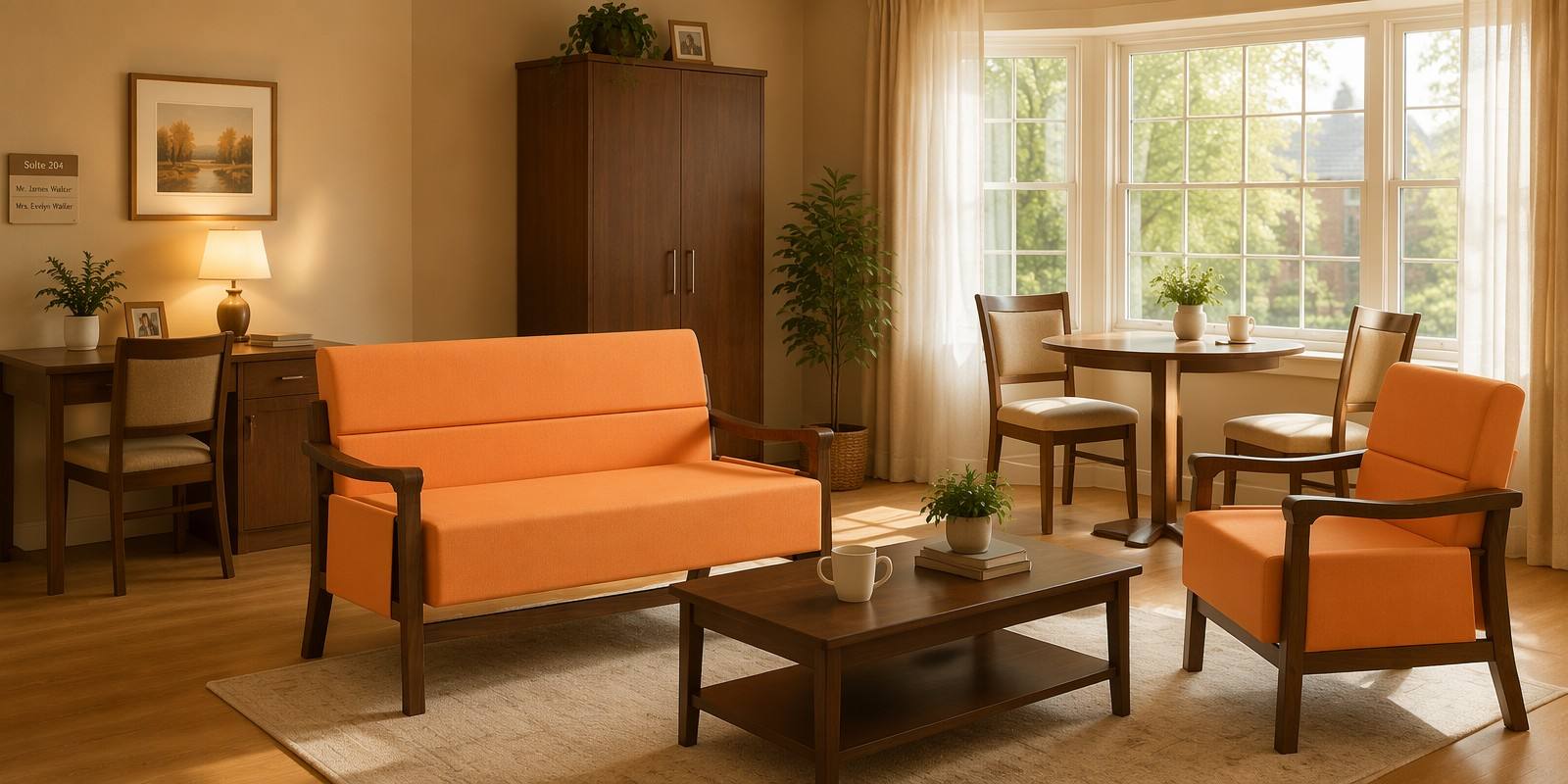
Sculpted Continuous Armrest Curve — Single-piece hardwood flow from backrest crest to front-leg joint creates a natural, intuitive grip zone at 640 mm apex for sit-to-stand support. No sharp transitions, no pinch points.
2-Section Structural Backrest — The deep horizontal seam is not decorative: it divides the backrest into upper and lower panels, each independently supported. This prevents the single-panel fabric sag common in long-span loveseats after 12+ months of institutional use.
Angled Rear Leg Anti-Tip Geometry — Rear legs splay outward at 7°, widening the base stance beyond the seat width. Combined with front-to-rear stretcher bars, this creates a stable platform even when a 120 kg user pushes down on one armrest to stand.
350g/m² Woven Canvas Upholstery — Heavier fabric weight than standard residential loveseats (typically 200–250g/m²). The tight weave resists abrasion from clothing, bags, and mobility aids. OEKO-TEX certified for healthcare indoor air quality.
Removable Side Panels — Vertical fabric side panels attach via concealed zippers. Removable for deep cleaning or replacement without disassembling the frame. Keeps the space between legs visually clean and prevents debris accumulation.
Knock-Down Flat-Pack — Ships disassembled for 40% freight cost reduction. Pre-installed threaded inserts and cam-lock joinery eliminate wood screw stripping. Assembly under 15 minutes with 2 personnel.
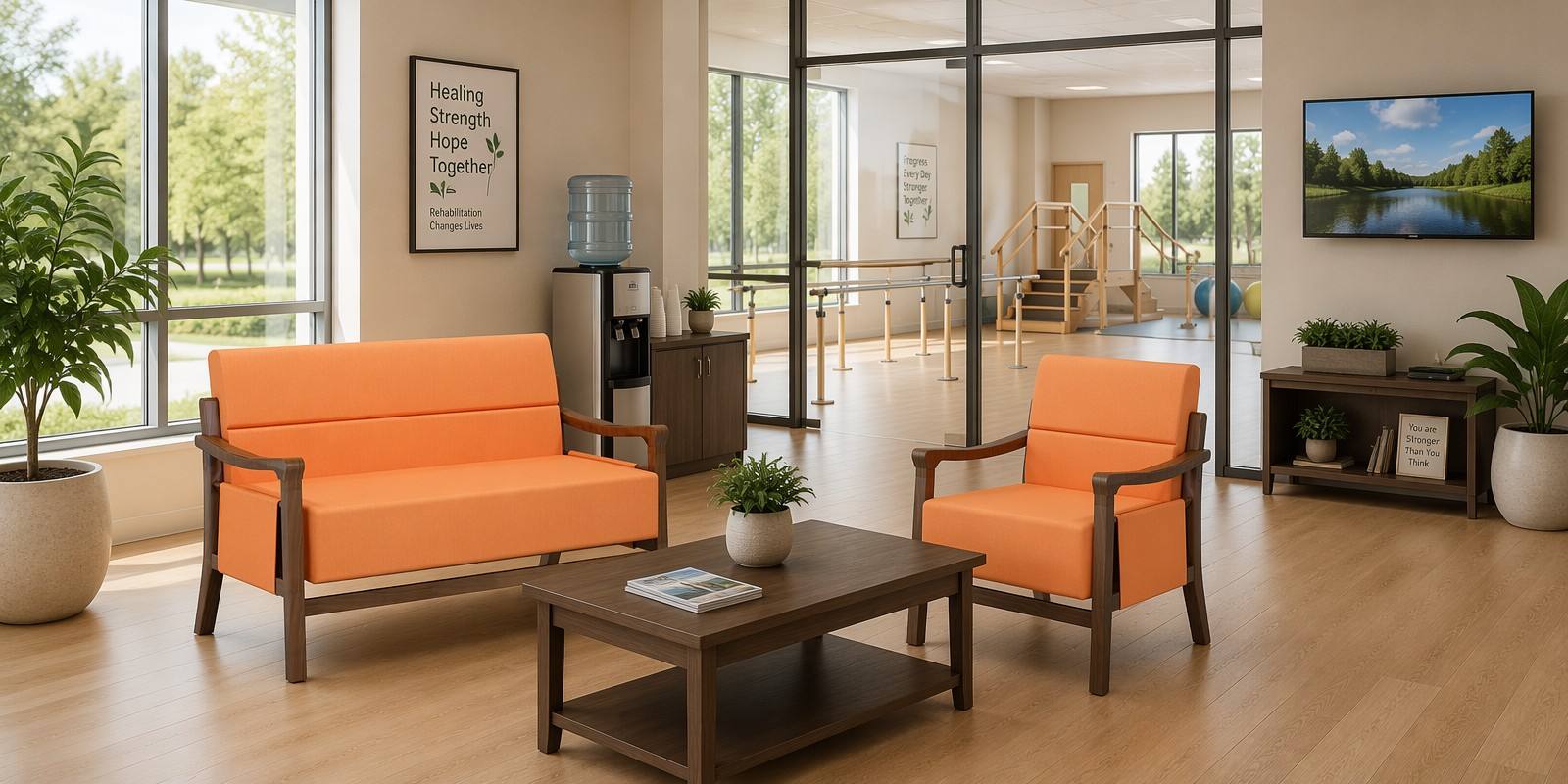
Residential Warmth, Institutional Toughness — The apricot orange fabric and sculpted wood armrests read as "living room furniture," not "hospital equipment." Patients and families feel at ease. Behind the aesthetic: 350g/m² commercial-grade canvas and satin-lacquered hardwood rated for healthcare disinfectant protocols.
The Armrest Is a Mobility Aid — Every curve in the armrest profile serves the sit-to-stand biomechanics of elderly and post-surgical patients. The 640 mm apex is calculated for average elbow height when pushing up; the continuous downward-front flow provides a sliding grip path for those who need to reposition mid-motion.
Two Back Sections = No Sag — Unlike single-panel loveseat backs that develop a central slump within 18 months, the divided backrest distributes tension across two independent panels. Each panel can be reupholstered separately if damaged — no need to replace the entire backrest.
Fabric That Breathes (and Washes) — Unlike sealed vinyl that traps heat and moisture, the tight-weave polyester canvas allows airflow through the seat and back. Patients sitting for extended periods — dialysis, chemotherapy, family vigils — stay cooler and more comfortable. Machine-washable covers for deep cleaning between occupants.
7° of Stability Engineering — The outward-angled rear legs are not a style choice. They create a wider floor-contact polygon that resists tipping when force is applied asymmetrically — exactly what happens when a patient pushes off one armrest with 80% of body weight. Standard parallel-leg loveseats tip; this one doesn't.
Healthcare interior designers are caught between two competing mandates: create a healing, non-institutional environment that reduces patient anxiety (Patient Experience), and specify furniture that survives aggressive cleaning, heavy use, and abuse (Facilities Management). "Residential-grade" loveseats brought into clinical spaces fail within 12–18 months — fabric pills and tears, frames loosen, cushions collapse. "Institutional-grade" alternatives are cold, clinical, and sabotage the healing atmosphere.
This 2-seater loveseat resolves the conflict through material selection and structural engineering, not compromise. The 350g/m² woven polyester canvas is residential in appearance and touch, but commercial in durability — tight-weave construction prevents snagging from IV poles and wheelchair hardware, while OEKO-TEX certification ensures no off-gassing in sensitive clinical environments. The sculpted dark wood frame uses the same satin lacquer finish as fine furniture, but applied in 3 coats with intercoat sanding — resisting the alcohol-based hand sanitizer and disinfectant wipes that cloud standard furniture finishes within weeks. The armrest curve is the product's defining visual feature and its most important functional element: a mid-century design gesture that doubles as a calibrated mobility aid for elderly, bariatric, and post-operative patients who need leverage to stand. The result is a loveseat that satisfies the Interior Design committee's aesthetic brief, the Infection Control team's cleanability requirements, and the Risk Management department's safety standards — in a single SKU.
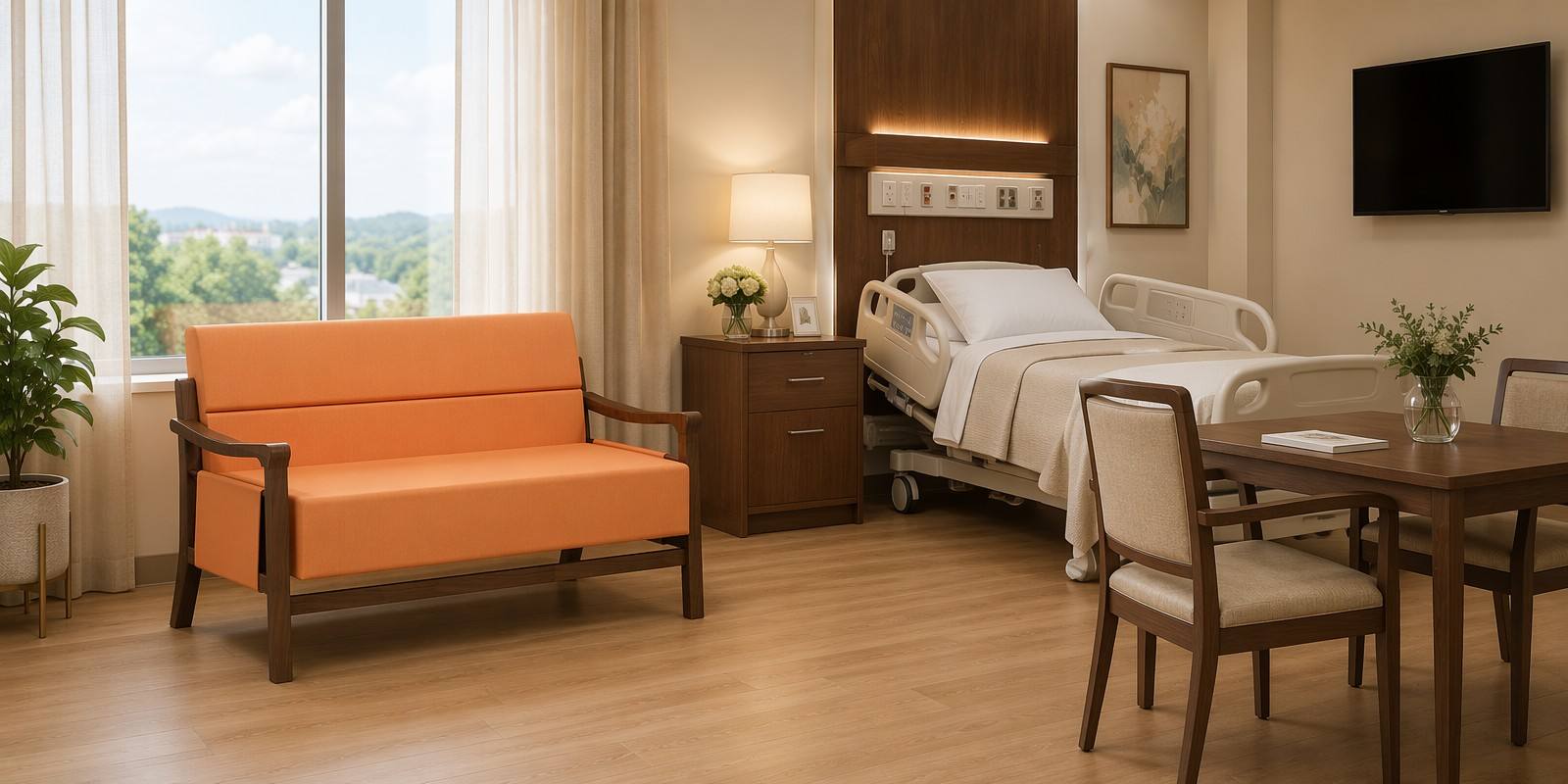
"Warmth Is a Clinical Intervention."
Decades of environmental psychology research confirm that patient recovery outcomes — pain perception, length of stay, satisfaction scores — are measurably influenced by the visual and tactile quality of the care environment. A cold room signals threat; a warm room signals safety. This loveseat is designed to be the single largest "warm" surface in an inpatient room or consultation suite.
The apricot orange upholstery was chosen deliberately. In color psychology for healthcare, warm orange tones reduce perceived waiting time, lower blood pressure readings in anxious patients, and create visual contrast against the ubiquitous white and beige of clinical walls. The dark walnut-stained hardwood frame provides a grounding, masculine counterweight — preventing the loveseat from reading as juvenile or decorative.
The sculpted armrest references Danish mid-century design, chosen for its visual lightness and its biomechanical suitability for medical use. Unlike boxy contemporary armrests that offer a single flat surface, the continuous curved profile supports multiple hand positions — palm-down for casual sitting, fist-grip for standing leverage, open-hand slide for repositioning. The form is beautiful; the function is medical.
| Detail | Description |
|---|---|
| Armrest Curve Radius | 220 mm primary arc; transitions from backrest-plane vertical to seat-plane horizontal across a 180 mm vertical drop — creates a natural hand-slide path during sit-to-stand |
| Backrest Seam Position | Horizontal seam at 55% of backrest height from seat; divides lumbar support zone (lower) from thoracic support zone (upper) — each independently tensioned to prevent central fabric creep |
| Seat Cushion Edge | Square, 90° front edge with 8 mm internal radius on foam core; maintains crisp visual line while eliminating hard-contact bruising on the back of thighs |
| Leg-to-Floor Contact | 4-point contact with 50×50 mm front pads and 45×35 mm rear pads; TPE non-slip, non-marking foot inserts; total 8,575 mm² floor contact area distributing 300 kg load |
| Stretcher Height | 65 mm above floor; allows robotic floor cleaner and mop access beneath the frame without catching; above typical 50 mm door threshold clearance |
| Frame Joinery | Mortise-and-tenon at armrest-to-leg joints; dowel-reinforced at backrest-to-seat rail connection; all structural joints glued with Type-III waterproof adhesive |
| Cushion Retention | Concealed hook-and-loop strips (40 mm wide) at 4 anchor points per cushion; holds cushions flush against frame during lateral patient movement while enabling 30-second removal |
| Side Panel Zipper | #5 nylon coil zipper with auto-lock slider; concealed behind fabric welt; allows panel removal for machine washing without affecting frame structure |
| Wood Plug Caps | Matching walnut-stained maple plugs (12 mm diameter) over all bolt recesses; sanded flush and finished to match frame — zero exposed metal in patient contact zones |
| Fabric Seam Allowance | 25 mm seam allowance on all upholstery panels; double-stitched with UV-resistant polyester thread; tested to 45 kg seam-slippage resistance per ISO 13936-2 |
Delivery
FOB Port: Shenzhen / Guangzhou / Shanghai (customer nominated)
Lead Time: 25–35 days for standard orders; 45–60 days for custom configurations
Packaging: KD flat-pack in 5-layer corrugated master carton with molded EPE foam end-caps and corner protectors; 1 unit per carton
Carton Dimensions: 1550 × 750 × 300 mm, 38 kg gross
Container Loading: 40HQ fits approximately 120 units (KD); 20GP fits approximately 55 units (KD)
Shipping Terms: FOB / CIF / DDP available; customer-assigned forwarders accepted
Sample Lead Time: 7–10 days for stock finish; 15–20 days for custom fabric or stain
Sample Shipping: DHL / FedEx / UPS; sample cost deducted from first bulk order invoice
Returns
Manufacturing defect claims must be submitted within 14 days of delivery with dated photographic evidence and carton label
Custom fabric color, custom wood stain, or custom dimension orders are non-returnable and non-refundable
Return shipping at buyer's expense unless defect is confirmed by our QC inspection report
Replacement parts or full-unit replacement shipped at no charge for verified warranty claims
Refunds processed within 10 business days of returned goods receipt and inspection
| Coverage | Duration | Scope |
|---|---|---|
| Solid Hardwood Frame | 5 Years | Structural integrity, joint separation, mortise-and-tenon failure, warping, cracking under normal institutional use |
| Fabric Upholstery | 2 Years | Pilling, seam separation, color fading beyond 4 Delta-E units, fabric tear at non-seam areas under normal use |
| Cushion Foam Core | 2 Years | Thickness loss exceeding 15% of original; permanent compression set visible when unoccupied |
| Hardware & Fasteners | 5 Years | Corrosion, thread failure, cam-lock mechanism failure under normal assembly torque |
| Surface Finish | 2 Years | Peeling, blistering, clouding, or significant discoloration under standard healthcare cleaning protocols |
| Zippers & Hook-and-Loop | 1 Year | Zipper slider failure, hook-and-loop loss of adhesion beyond 50% of original grip strength |
Exclusions: Damage from misuse, abuse, unauthorized structural modification, use of non-approved solvent-based or abrasive cleaners, outdoor exposure, or failure to follow assembly instructions. Warranty void if weight capacity is exceeded. Fabric pilling from abrasive clothing or equipment (wheelchair wheels, walker frames) is considered normal wear.
Q: What fabric colors are available beyond apricot orange? A: Our healthcare-grade polyester canvas library includes 50+ colors: warm gray, navy, forest green, burgundy, taupe, charcoal, teal, and many more. Custom Pantone-matched fabric dye lots available for orders of 50+ units. All colors carry the same OEKO-TEX certification and abrasion-resistance rating.
Q: Can the wood finish be changed from dark walnut to a lighter tone? A: Yes. The frame is available in natural oak (light), honey maple (medium), or dark walnut (shown). Custom stain matching to your facility's existing millwork is available for orders of 30+ units. All finishes use the same satin lacquer for consistent cleanability.
Q: How do I clean and disinfect the fabric upholstery? A: Daily: vacuum or lint-roll. Spot-clean with mild detergent and damp cloth. For healthcare disinfection: spray with 70% isopropyl alcohol or quaternary ammonium solution, allow 2-minute dwell time, blot dry. The polyester canvas is colorfast to alcohol-based disinfectants. Deep clean: removable covers and side panels are machine-washable at 60°C (140°F). Do not use bleach or peroxide-based cleaners on colored fabrics.
Q: Is this loveseat suitable for bariatric patients? A: The standard model is rated to 150 kg per seat (300 kg total). For bariatric requirements, we offer a reinforced variant (HY-MWL-2S-B) with internal steel frame bracing, upgraded 55D foam, and widened armrest openings — rated to 250 kg per seat. Visually consistent with the standard model.
Q: Can the loveseat be fixed to the floor? A: Yes. Each leg base has a pre-drilled anchor point accessible by removing the TPE foot pad. M8 expansion anchor hardware is included for concrete substrates. Floor-mounting does not affect the warranty. For raised-access flooring, surface-mount L-brackets are available upon request.
Q: Does the fabric meet healthcare fire safety standards? A: The standard polyester canvas meets California Technical Bulletin CAL 117-2013 (Section E). For facilities requiring higher fire ratings, we offer a fire-retardant (FR) fabric variant meeting BS 5852 Crib 5 (UK) and EN 1021-1/2 (EU). CAL 133 (high-hazard behavioral health) compliance available at surcharge. FR fabric adds approximately 12% to unit cost.
Q: What other furniture do you manufacture in the same dark wood + fabric series? A: The Hongye MedCare mid-century series includes: 3-seater waiting sofas, single visitor armchairs, hospital bedside cabinets, overbed tables, doctor consultation desks, senior living dining chairs, and coffee tables. All share the same dark walnut satin-lacquered wood and coordinated fabric palette — enabling a unified interior design language across your entire facility. A project catalog with SKU matrix is available on request.
Q: How long will this loveseat last in a busy hospital inpatient room? A: With standard daily cleaning and disinfection, the frame is rated for 8–10 years of continuous institutional service. The fabric upholstery is rated for 5–7 years before cosmetic replacement is recommended. Removable covers can extend the aesthetic life of cushions; replacement covers are available as spare parts without purchasing a new loveseat.
Q: What is the difference between this loveseat and your medical waiting bench or 3-seater sofa? A: The 2-seater loveseat (this product) is designed for intimate settings — inpatient rooms, doctor offices, small consultation suites — where space is limited and a personal, residential feel is paramount. The 3-seater medical sofa (separate SKU) is built for higher-capacity waiting areas with island armrest dividers. The corridor bench (separate SKU) is optimized for hallway and high-traffic public spaces. All three share the same wood species and finish options for cross-project consistency.
Product Details
Where most medical seating opts for cold vinyl, this loveseat brings residential warmth into clinical spaces without sacrificing cleanability. The 2-section backrest with a deep horizontal seam provides targeted lumbar and upper-back support — the seam itself is a structural feature that prevents single-panel fabric sag over years of use. The sculpted armrest profile is intentional: it descends from the backrest, then gently curves upward, offering a natural handhold for elderly and mobility-impaired patients transitioning from seated to standing. Horizontal stretchers between front and rear legs provide anti-rack rigidity, while the angled back legs shift the center of gravity rearward for anti-tip stability even when users lean heavily forward on the armrests.
Attribute Table
Attribute Specification
Model HY-MWL-2S
Product Type 2-Seater Medical Loveseat / Healthcare Visitor Sofa
Overall Dimensions (L×W×H) 1500 × 720 × 830 mm (customizable)
Seat Height 450 mm
Seat Depth 520 mm
Backrest Height 380 mm
Armrest Height 640 mm (apex of curve)
Frame Material Solid Oak / Walnut-Stained Hardwood, E1-Grade
Frame Finish Satin Lacquer (Dark Brown, Natural Grain)
Upholstery Material 100% Polyester, 350g/m², Tight-Weave Canvas
Upholstery Color Apricot Orange (custom colors available)
Cushion Core High-Density PU Foam (45D seat / 38D back)
Backrest Structure 2-Section with Inset Structural Seam
Armrest Design Sculpted Curvilinear — Backrest-to-Front-Joint Flow
Weight Capacity 300 kg total (150 kg per seat)
Net Weight 35 kg
Packing Knock-Down (KD) Flat-Pack, 1 unit/carton
Installation Assembly Required, Tools & Manual Included
MOQ 5 Units
Delivery Time 25–35 Days (FOB)
Certification ISO 9001, CE, ANSI/BIFMA, OEKO-TEX (Fabric)
Warranty 5-Year Frame / 2-Year Upholstery
Customization Size, Wood Stain, Fabric Color/Pattern, Armrest Profile
Dimensions (mm)
┌─────────────────────────────────────────────────┐
│ 1500 mm │
│ ┌─────────────────────────────────────────┐ │
│ │ 2-Section Backrest │ │
│ │ ┌──────────────┬──────────────┐ │ │
│ │ │ Section 1 │ Section 2 │ 380 │ │
│ │ │ 750 × 380 │ 750 × 380 │ mm │ 830
│ │ └──────────────┴──────────────┘ │ │ mm
│ │ ══════════════════════════════ │ │
│ │ Seat Cushion (1500 × 520) │ │
│ │ ┌─────────────────────────────────┐ │ │
│ │ │ Single Span │ │ │
│ │ └─────────────────────────────────┘ │ │
│ └─────────────────────────────────────────┘ │
│ ▲ 720 mm ▲ │
│ Front Legs (square) Back Legs (angled) │
│ [ Stretcher Bar ] [ Stretcher Bar ] │
└─────────────────────────────────────────────────┘
Materials
Component Material Description
Frame Solid Oak / Walnut-Stained Hardwood, E1-Grade Sustainably sourced; dense grain structure resists denting from mobility aids and equipment impact
Armrests Solid Hardwood (Sculpted Profile) Single-piece continuous curve from backrest joint to front leg; 42 mm diameter at grip zone for elderly hand comfort
Front Legs Solid Hardwood (Square, 50×50 mm) Vertical load-bearing posts with 3° inward taper for visual lightness without sacrificing cross-section
Rear Legs Solid Hardwood (Tapered, 7° Angle) Angled outward for anti-tip stability; wider stance at floor than at frame joint
Stretcher Bars Solid Hardwood (Horizontal) Front-to-rear connecting bars at leg base; prevent racking and frame twist under lateral loading
Seat Cushion High-Density PU Foam (45D) + Polyester Wrap 120 mm thickness; Dacron-wrapped for crown softness with deep support; resists bottoming-out after extended sitting
Back Cushions Medium-Density PU Foam (38D) + Polyester Wrap 2 independent sections separated by structural seam; each 80 mm thick with contoured lumbar curve
Upholstery 100% Polyester Canvas, 350g/m² Tight-weave construction resists pilling and snagging; colorfast to hospital laundry detergents; OEKO-TEX certified
Side Panels 100% Polyester (Matching) Vertical fabric panels covering space between front/rear legs; attached via concealed zipper for removable cleaning
Hardware Stainless Steel M8 Bolts + Threaded Inserts Pre-installed factory inserts; corrosion-resistant; all bolt heads recessed and capped with matching wood plugs
Finish Satin Lacquer, Dark Walnut Tone Non-toxic, low-VOC; 3-coat application with 400-grit intercoat sanding; scratch and moisture resistant
Features
Sculpted Continuous Armrest Curve — Single-piece hardwood flow from backrest crest to front-leg joint creates a natural, intuitive grip zone at 640 mm apex for sit-to-stand support. No sharp transitions, no pinch points.
2-Section Structural Backrest — The deep horizontal seam is not decorative: it divides the backrest into upper and lower panels, each independently supported. This prevents the single-panel fabric sag common in long-span loveseats after 12+ months of institutional use.
Angled Rear Leg Anti-Tip Geometry — Rear legs splay outward at 7°, widening the base stance beyond the seat width. Combined with front-to-rear stretcher bars, this creates a stable platform even when a 120 kg user pushes down on one armrest to stand.
350g/m² Woven Canvas Upholstery — Heavier fabric weight than standard residential loveseats (typically 200–250g/m²). The tight weave resists abrasion from clothing, bags, and mobility aids. OEKO-TEX certified for healthcare indoor air quality.
Removable Side Panels — Vertical fabric side panels attach via concealed zippers. Removable for deep cleaning or replacement without disassembling the frame. Keeps the space between legs visually clean and prevents debris accumulation.
Knock-Down Flat-Pack — Ships disassembled for 40% freight cost reduction. Pre-installed threaded inserts and cam-lock joinery eliminate wood screw stripping. Assembly under 15 minutes with 2 personnel.
Product Advantage (5 Concise Selling Points)
Residential Warmth, Institutional Toughness — The apricot orange fabric and sculpted wood armrests read as "living room furniture," not "hospital equipment." Patients and families feel at ease. Behind the aesthetic: 350g/m² commercial-grade canvas and satin-lacquered hardwood rated for healthcare disinfectant protocols.
The Armrest Is a Mobility Aid — Every curve in the armrest profile serves the sit-to-stand biomechanics of elderly and post-surgical patients. The 640 mm apex is calculated for average elbow height when pushing up; the continuous downward-front flow provides a sliding grip path for those who need to reposition mid-motion.
Two Back Sections = No Sag — Unlike single-panel loveseat backs that develop a central slump within 18 months, the divided backrest distributes tension across two independent panels. Each panel can be reupholstered separately if damaged — no need to replace the entire backrest.
Fabric That Breathes (and Washes) — Unlike sealed vinyl that traps heat and moisture, the tight-weave polyester canvas allows airflow through the seat and back. Patients sitting for extended periods — dialysis, chemotherapy, family vigils — stay cooler and more comfortable. Machine-washable covers for deep cleaning between occupants.
7° of Stability Engineering — The outward-angled rear legs are not a style choice. They create a wider floor-contact polygon that resists tipping when force is applied asymmetrically — exactly what happens when a patient pushes off one armrest with 80% of body weight. Standard parallel-leg loveseats tip; this one doesn't.
Solution to the Pain Point
Healthcare interior designers are caught between two competing mandates: create a healing, non-institutional environment that reduces patient anxiety (Patient Experience), and specify furniture that survives aggressive cleaning, heavy use, and abuse (Facilities Management). "Residential-grade" loveseats brought into clinical spaces fail within 12–18 months — fabric pills and tears, frames loosen, cushions collapse. "Institutional-grade" alternatives are cold, clinical, and sabotage the healing atmosphere.
This 2-seater loveseat resolves the conflict through material selection and structural engineering, not compromise. The 350g/m² woven polyester canvas is residential in appearance and touch, but commercial in durability — tight-weave construction prevents snagging from IV poles and wheelchair hardware, while OEKO-TEX certification ensures no off-gassing in sensitive clinical environments. The sculpted dark wood frame uses the same satin lacquer finish as fine furniture, but applied in 3 coats with intercoat sanding — resisting the alcohol-based hand sanitizer and disinfectant wipes that cloud standard furniture finishes within weeks. The armrest curve is the product's defining visual feature and its most important functional element: a mid-century design gesture that doubles as a calibrated mobility aid for elderly, bariatric, and post-operative patients who need leverage to stand. The result is a loveseat that satisfies the Interior Design committee's aesthetic brief, the Infection Control team's cleanability requirements, and the Risk Management department's safety standards — in a single SKU.
Design Philosophy
"Warmth Is a Clinical Intervention."
Decades of environmental psychology research confirm that patient recovery outcomes — pain perception, length of stay, satisfaction scores — are measurably influenced by the visual and tactile quality of the care environment. A cold room signals threat; a warm room signals safety. This loveseat is designed to be the single largest "warm" surface in an inpatient room or consultation suite.
The apricot orange upholstery was chosen deliberately. In color psychology for healthcare, warm orange tones reduce perceived waiting time, lower blood pressure readings in anxious patients, and create visual contrast against the ubiquitous white and beige of clinical walls. The dark walnut-stained hardwood frame provides a grounding, masculine counterweight — preventing the loveseat from reading as juvenile or decorative.
The sculpted armrest references Danish mid-century design, chosen for its visual lightness and its biomechanical suitability for medical use. Unlike boxy contemporary armrests that offer a single flat surface, the continuous curved profile supports multiple hand positions — palm-down for casual sitting, fist-grip for standing leverage, open-hand slide for repositioning. The form is beautiful; the function is medical.
Design Details
Detail Description
Armrest Curve Radius 220 mm primary arc; transitions from backrest-plane vertical to seat-plane horizontal across a 180 mm vertical drop — creates a natural hand-slide path during sit-to-stand
Backrest Seam Position Horizontal seam at 55% of backrest height from seat; divides lumbar support zone (lower) from thoracic support zone (upper) — each independently tensioned to prevent central fabric creep
Seat Cushion Edge Square, 90° front edge with 8 mm internal radius on foam core; maintains crisp visual line while eliminating hard-contact bruising on the back of thighs
Leg-to-Floor Contact 4-point contact with 50×50 mm front pads and 45×35 mm rear pads; TPE non-slip, non-marking foot inserts; total 8,575 mm² floor contact area distributing 300 kg load
Stretcher Height 65 mm above floor; allows robotic floor cleaner and mop access beneath the frame without catching; above typical 50 mm door threshold clearance
Frame Joinery Mortise-and-tenon at armrest-to-leg joints; dowel-reinforced at backrest-to-seat rail connection; all structural joints glued with Type-III waterproof adhesive
Cushion Retention Concealed hook-and-loop strips (40 mm wide) at 4 anchor points per cushion; holds cushions flush against frame during lateral patient movement while enabling 30-second removal
Side Panel Zipper #5 nylon coil zipper with auto-lock slider; concealed behind fabric welt; allows panel removal for machine washing without affecting frame structure
Wood Plug Caps Matching walnut-stained maple plugs (12 mm diameter) over all bolt recesses; sanded flush and finished to match frame — zero exposed metal in patient contact zones
Fabric Seam Allowance 25 mm seam allowance on all upholstery panels; double-stitched with UV-resistant polyester thread; tested to 45 kg seam-slippage resistance per ISO 13936-2
Delivery & Returns
Delivery
FOB Port: Shenzhen / Guangzhou / Shanghai (customer nominated)
Lead Time: 25–35 days for standard orders; 45–60 days for custom configurations
Packaging: KD flat-pack in 5-layer corrugated master carton with molded EPE foam end-caps and corner protectors; 1 unit per carton
Carton Dimensions: 1550 × 750 × 300 mm, 38 kg gross
Container Loading: 40HQ fits approximately 120 units (KD); 20GP fits approximately 55 units (KD)
Shipping Terms: FOB / CIF / DDP available; customer-assigned forwarders accepted
Sample Lead Time: 7–10 days for stock finish; 15–20 days for custom fabric or stain
Sample Shipping: DHL / FedEx / UPS; sample cost deducted from first bulk order invoice
Returns
Manufacturing defect claims must be submitted within 14 days of delivery with dated photographic evidence and carton label
Custom fabric color, custom wood stain, or custom dimension orders are non-returnable and non-refundable
Return shipping at buyer's expense unless defect is confirmed by our QC inspection report
Replacement parts or full-unit replacement shipped at no charge for verified warranty claims
Refunds processed within 10 business days of returned goods receipt and inspection
Warranty
Coverage Duration Scope
Solid Hardwood Frame 5 Years Structural integrity, joint separation, mortise-and-tenon failure, warping, cracking under normal institutional use
Fabric Upholstery 2 Years Pilling, seam separation, color fading beyond 4 Delta-E units, fabric tear at non-seam areas under normal use
Cushion Foam Core 2 Years Thickness loss exceeding 15% of original; permanent compression set visible when unoccupied
Hardware & Fasteners 5 Years Corrosion, thread failure, cam-lock mechanism failure under normal assembly torque
Surface Finish 2 Years Peeling, blistering, clouding, or significant discoloration under standard healthcare cleaning protocols
Zippers & Hook-and-Loop 1 Year Zipper slider failure, hook-and-loop loss of adhesion beyond 50% of original grip strength
Exclusions: Damage from misuse, abuse, unauthorized structural modification, use of non-approved solvent-based or abrasive cleaners, outdoor exposure, or failure to follow assembly instructions. Warranty void if weight capacity is exceeded. Fabric pilling from abrasive clothing or equipment (wheelchair wheels, walker frames) is considered normal wear.
FAQ
Q: What fabric colors are available beyond apricot orange? A: Our healthcare-grade polyester canvas library includes 50+ colors: warm gray, navy, forest green, burgundy, taupe, charcoal, teal, and many more. Custom Pantone-matched fabric dye lots available for orders of 50+ units. All colors carry the same OEKO-TEX certification and abrasion-resistance rating.
Q: Can the wood finish be changed from dark walnut to a lighter tone? A: Yes. The frame is available in natural oak (light), honey maple (medium), or dark walnut (shown). Custom stain matching to your facility's existing millwork is available for orders of 30+ units. All finishes use the same satin lacquer for consistent cleanability.
Q: How do I clean and disinfect the fabric upholstery? A: Daily: vacuum or lint-roll. Spot-clean with mild detergent and damp cloth. For healthcare disinfection: spray with 70% isopropyl alcohol or quaternary ammonium solution, allow 2-minute dwell time, blot dry. The polyester canvas is colorfast to alcohol-based disinfectants. Deep clean: removable covers and side panels are machine-washable at 60°C (140°F). Do not use bleach or peroxide-based cleaners on colored fabrics.
Q: Is this loveseat suitable for bariatric patients? A: The standard model is rated to 150 kg per seat (300 kg total). For bariatric requirements, we offer a reinforced variant (HY-MWL-2S-B) with internal steel frame bracing, upgraded 55D foam, and widened armrest openings — rated to 250 kg per seat. Visually consistent with the standard model.
Q: Can the loveseat be fixed to the floor? A: Yes. Each leg base has a pre-drilled anchor point accessible by removing the TPE foot pad. M8 expansion anchor hardware is included for concrete substrates. Floor-mounting does not affect the warranty. For raised-access flooring, surface-mount L-brackets are available upon request.
Q: Does the fabric meet healthcare fire safety standards? A: The standard polyester canvas meets California Technical Bulletin CAL 117-2013 (Section E). For facilities requiring higher fire ratings, we offer a fire-retardant (FR) fabric variant meeting BS 5852 Crib 5 (UK) and EN 1021-1/2 (EU). CAL 133 (high-hazard behavioral health) compliance available at surcharge. FR fabric adds approximately 12% to unit cost.
Q: What other furniture do you manufacture in the same dark wood + fabric series? A: The Hongye MedCare mid-century series includes: 3-seater waiting sofas, single visitor armchairs, hospital bedside cabinets, overbed tables, doctor consultation desks, senior living dining chairs, and coffee tables. All share the same dark walnut satin-lacquered wood and coordinated fabric palette — enabling a unified interior design language across your entire facility. A project catalog with SKU matrix is available on request.
Q: How long will this loveseat last in a busy hospital inpatient room? A: With standard daily cleaning and disinfection, the frame is rated for 8–10 years of continuous institutional service. The fabric upholstery is rated for 5–7 years before cosmetic replacement is recommended. Removable covers can extend the aesthetic life of cushions; replacement covers are available as spare parts without purchasing a new loveseat.
Q: What is the difference between this loveseat and your medical waiting bench or 3-seater sofa? A: The 2-seater loveseat (this product) is designed for intimate settings — inpatient rooms, doctor offices, small consultation suites — where space is limited and a personal, residential feel is paramount. The 3-seater medical sofa (separate SKU) is built for higher-capacity waiting areas with island armrest dividers. The corridor bench (separate SKU) is optimized for hallway and high-traffic public spaces. All three share the same wood species and finish options for cross-project consistency.
The 2026 FIFA World Cup will host 48 matches across 16 stadiums in the United States, Mexico, and Canada, with cumulative attendance projected at around 5.4 million spectators. Behind every match, each stadium must operate a fully equipped medical infrastructure capable of handling everything from m
Strange medical furniture innovations follow a completely different rulebook than any other furniture category. A chair in a hospital is not just a place to sit—it might need to resist bacteria colonization, support 200–500 kg patients, prevent self‑harm, or integrate with dialysis machines and ceil
Rehabilitation center furniture design requires a fundamentally different approach than general medical office or acute care hospital furniture. Rehabilitation center furniture must serve patients across the full mobility continuum—from bed rest and maximum‑assistance transfers to independent commun
Dialysis center furniture design presents unique challenges that standard healthcare furniture cannot fully address. Patients typically spend three to five hours per session, three times per week, so dialysis center specialized seating and treatment room layout directly affect treatment compliance,
Patient room furniture design sits at the intersection of clinical functionality, regulatory compliance, and human‑centered care. When hospital patient room furniture is treated like standard commercial casework and seating, the result is often higher fall risk, accessibility gaps, increased infecti
Introduction: Why Hospital‑Grade Furniture Materials Are a Risk Decision, Not a Design ChoiceIn healthcare furniture procurement, the material specification is not a design preference. It is a risk‑management decision that affects infection control, life safety, and long‑term cost.A single C. diff s