
Views: 0 Author: Site Editor Publish Time: 2026-06-10 Origin: Site


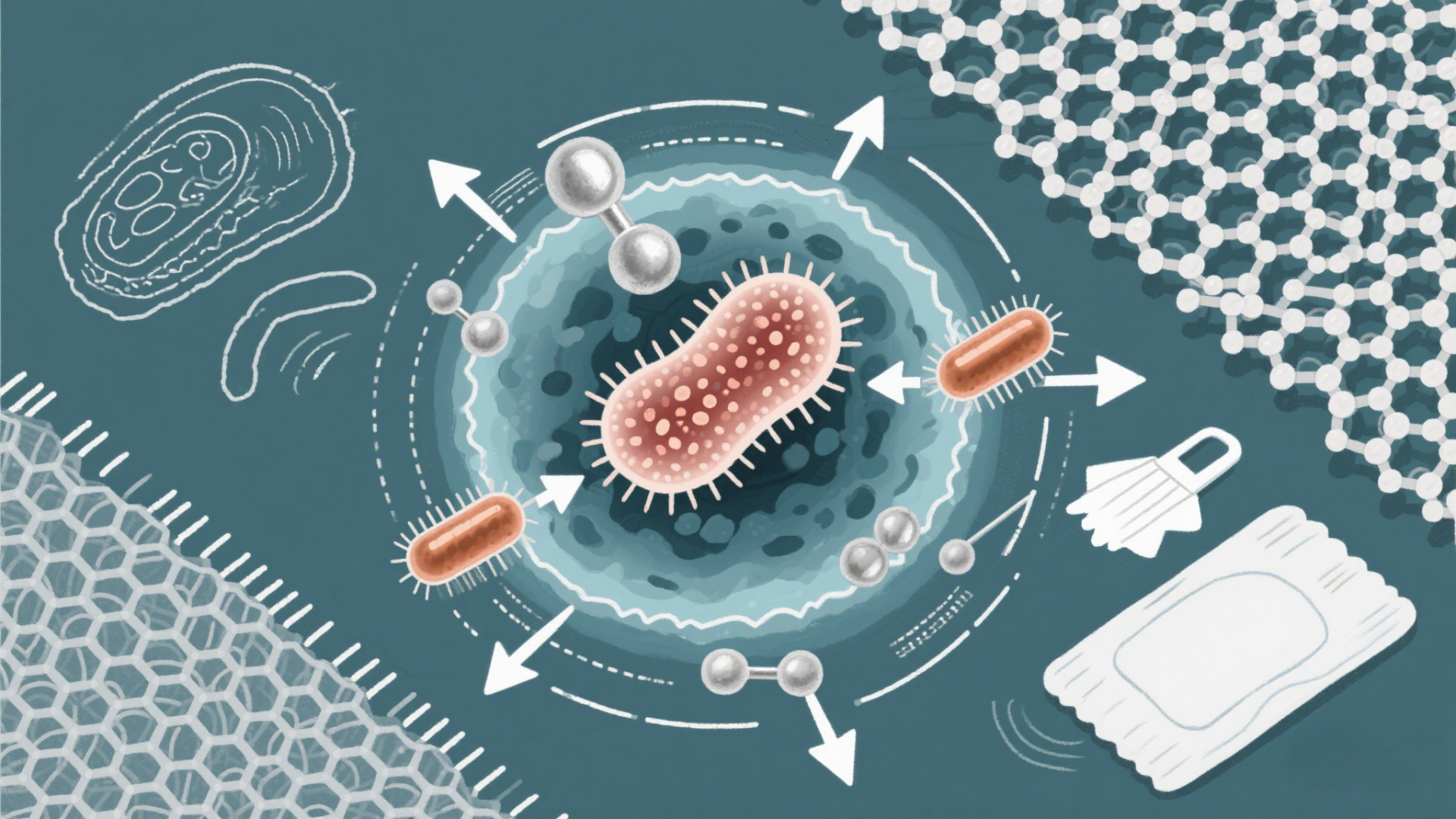
In healthcare furniture procurement, the material specification is not a design preference. It is a risk‑management decision that affects infection control, life safety, and long‑term cost.
A single C. diff spore surviving on a chair armrest can trigger an outbreak that costs a hospital more than the entire furniture budget for that wing. Fire‑rated seating that fails mid‑project can delay a JCI inspection by six months. “Antimicrobial” fabric that is only a marketing claim can even void infection‑control insurance coverage.
From our projects across U.S. hospitals, Middle East clinics, and Southeast Asia healthcare campuses, the most expensive mistakes in hospital furniture materials usually come from three sources: specifying “antimicrobial” without verification, misunderstanding fire‑rating standards across markets, and choosing “cleanable” surfaces that look good on day one but degrade after 50 cleaning cycles.
If you specify hospital‑grade furniture materials without hard test data for antimicrobial performance, fire rating, and cleanability, you are effectively accepting higher infection risk, delayed approvals, and early material failure.
In this 2026 guide, you will learn the three non‑negotiable filters for hospital‑grade furniture materials, a material‑by‑material specification guide for seating, casegoods, and beds, market‑specific fire and safety standards, the most common specification mistakes to avoid, and how a healthcare furniture manufacturer can support you with verifiable test reports.
Every healthcare furniture materials specification should start with three filters.
If a material does not pass all three, it should not enter your RFQ.
| Material Layer | What to Specify | What to Avoid |
Fabric surface | Silver‑ion infused (built into fiber), >99.9% reduction per ISO 20743 or 22196 | “Antimicrobial by treatment” that fades after ~20 wash cycles |
Foam interior | Open‑cell PU, density ≥ 1.8 lb/ft³, antimicrobial additive in foam formulation | Closed‑cell foam that traps moisture; generic foams with no additive |
Frame/legs | Powder‑coated steel with smooth welds, no exposed threads | Raw steel with simple paint; decorative joints that trap dust |
Fasteners | Stainless steel (304 or 316) screws and bolts | Zinc‑plated steel that corrodes in 12–18 months in humid areas |
This table shows why you cannot rely on a single “antimicrobial” claim; each material layer—from fabric to fasteners—needs its own specification.
Verification tip: Ask for a test report from an accredited lab (for example SGS or Intertek) showing >99.9% reduction against Staphylococcus aureus, Escherichia coli, and ideally C. difficile. “Antimicrobial” without a test report is marketing, not specification.
Fire standards for hospital furniture materials differ by market.
Specifying CAL 133 for a U.K. project wastes money; specifying BS 7176 for California is a compliance failure.
| Market | Standard | Test Method | What It Means |
U.S. | CAL 133, NFPA 260 | Mock‑up burn test, open flame | Required for healthcare in CA; de facto standard for U.S. seating |
U.K./EU | BS 7176, EN 1021 | Cigarette + match ignition | Source 5 (highest) usually required for healthcare environments |
Australia/NZ | AS/NZS 3837 | Cone calorimeter | Group 1 classification (≤150 kW/m² peak) |
China | GB 17927 | Cigarette test | Baseline; most factories in China certify to this by default |
Middle East | Local Civil Defense requirements | Varies by emirate | Dubai/Abu Dhabi have separate certifications and factory audits |
Mapping each project market to the correct fire standard prevents unnecessary retesting, failed inspections, and painful project delays.
Practical note: CAL 133 compliance typically adds around ¥200–400 per seating unit in China. For larger orders, per‑unit cost can drop, but you should still budget for it.
Healthcare furniture is cleaned with quaternary ammonium compounds, bleach solutions (up to 1,000 ppm), and alcohol‑based disinfectants. Materials that tolerate this exposure last 5–10 years; those that do not fail in 18–24 months.
| Material | Bleach Tolerance | Alcohol Tolerance | Expected Life (daily cleaning) |
Vinyl (expanded PVC) | Excellent (5,000+ cycles) | Excellent | 7–10 years |
Polyurethane (PU “faux leather”) | Good (~2,000 cycles) | Good | 5–7 years |
Silicone (advanced healthcare grade) | Excellent (10,000+ cycles) | Excellent | 10+ years |
Woven fabric (treated antimicrobial) | Poor (<500 cycles) | Poor | Not recommended for high‑infection areas |
Powder‑coat steel | Excellent | Excellent | 10+ years |
HPL laminate | Good | Excellent | 7–10 years |
These expected lifetimes under daily cleaning are often the real difference between a 3‑year and a 7‑year total cost of ownership for hospital seating and casegoods.
Once you have the three non‑negotiables clear, you can move into detailed material choices for different types of hospital furniture.
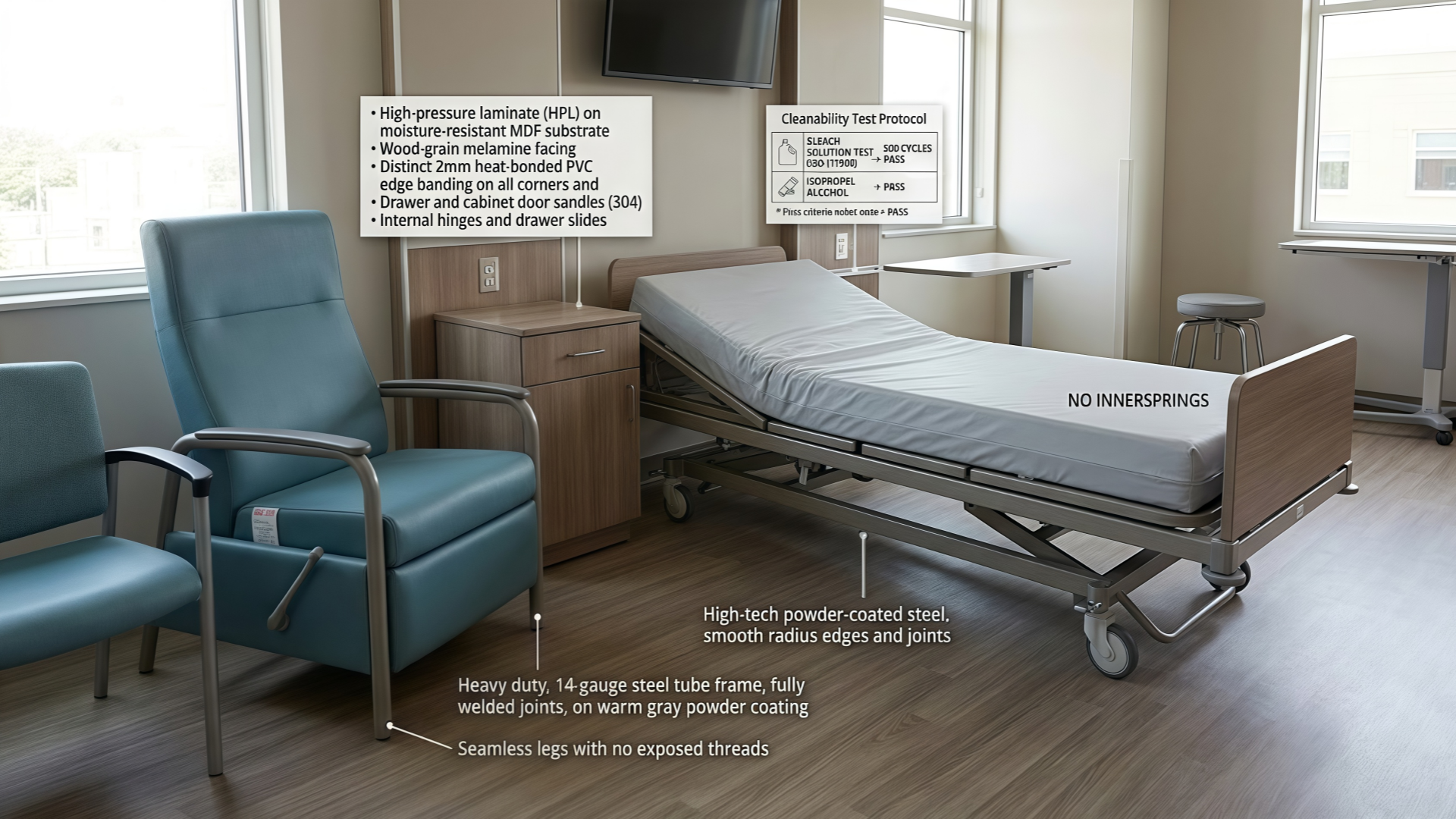
Frame
Specify 14‑gauge steel tube (wall thickness ≥ 1.5 mm) with fully welded joints.
Bolt‑together frames tend to loosen under dynamic loading within 12 months.
Foam
High‑resilience PU foam, density ≥ 1.8 lb/ft³ (around 30 kg/m³).
ILD (Indentation Load Deflection) 35–40 for seating surfaces.
CAL 133 foam formulations add fire‑retardant additives—verify that durability is not compromised.
Fabric
Vinyl (expanded PVC) with silver‑ion antimicrobial additive integrated into the material.
Minimum testing against multiple drug‑resistant strains (for example MRSA, VRE, ESBL).
Wyzenbeek abrasion: ≥ 100,000 double rubs for waiting room seating; ≥ 50,000 for patient room chairs.
Legs/Base
Powder‑coated steel with smooth radius edges and no exposed threads.
Cumulative weight rating ≥ 300 lb (136 kg) with a 4× safety factor for hospital seating.
These specifications help ensure hospital seating performs under 24/7 use, infection‑control cleaning, and bariatric loads.
Substrate
Moisture‑resistant MDF (MR‑MDF) with melamine facing, or plywood with HPL (high‑pressure laminate) overlay.
Avoid plain particleboard; it swells and fails after the first major spill.
Edges
PVC edge banding (≥ 2 mm), heat‑bonded rather than simply glued.
Taped or thin edges peel within months in high‑traffic healthcare environments.
Hardware
Stainless steel (304 grade) hinges and drawer slides.
Zinc‑plated hardware corrodes within 12–18 months in humid or coastal climates.
Hospital casegoods built on MR‑MDF or plywood with HPL and stainless hardware can deliver 7–10 years of reliable service under daily cleaning.
Mattress
Fluid‑proof cover (polyurethane or vinyl) with heat‑sealed seams.
Foam core with fire‑retardant formulation compliant with CAL 133 or local equivalent.
Specify “no innerspring mattresses” for infection control, as springs create voids that are hard to clean.
Bed Frame
Powder‑coated steel with seamless welds at joints.
Headboard and footboard corners radiused to ≤ 3 mm to reduce injury risk during patient transfer.
Using hospital‑grade mattress covers and bed frame materials prevents moisture ingress, facilitates cleaning, and reduces infection risk.
Ask the manufacturer for a cleaning‑cycle test report for their healthcare furniture materials:
Example Test Protocol (based on ISO 11998):
500 cycles: 1,000 ppm bleach solution, 30‑second dwell, wipe dry
500 cycles: 70% isopropyl alcohol, 10‑second dwell, wipe dry
Visual inspection after each 250 cycles
Pass criteria: No color change > ΔE 3.0, no surface cracking, no seam failure
If the healthcare furniture manufacturer cannot produce this report, the “hospital‑grade” fabric is likely not truly healthcare‑grade.
Even the best materials fail if they are tested to the wrong standard for your destination market.
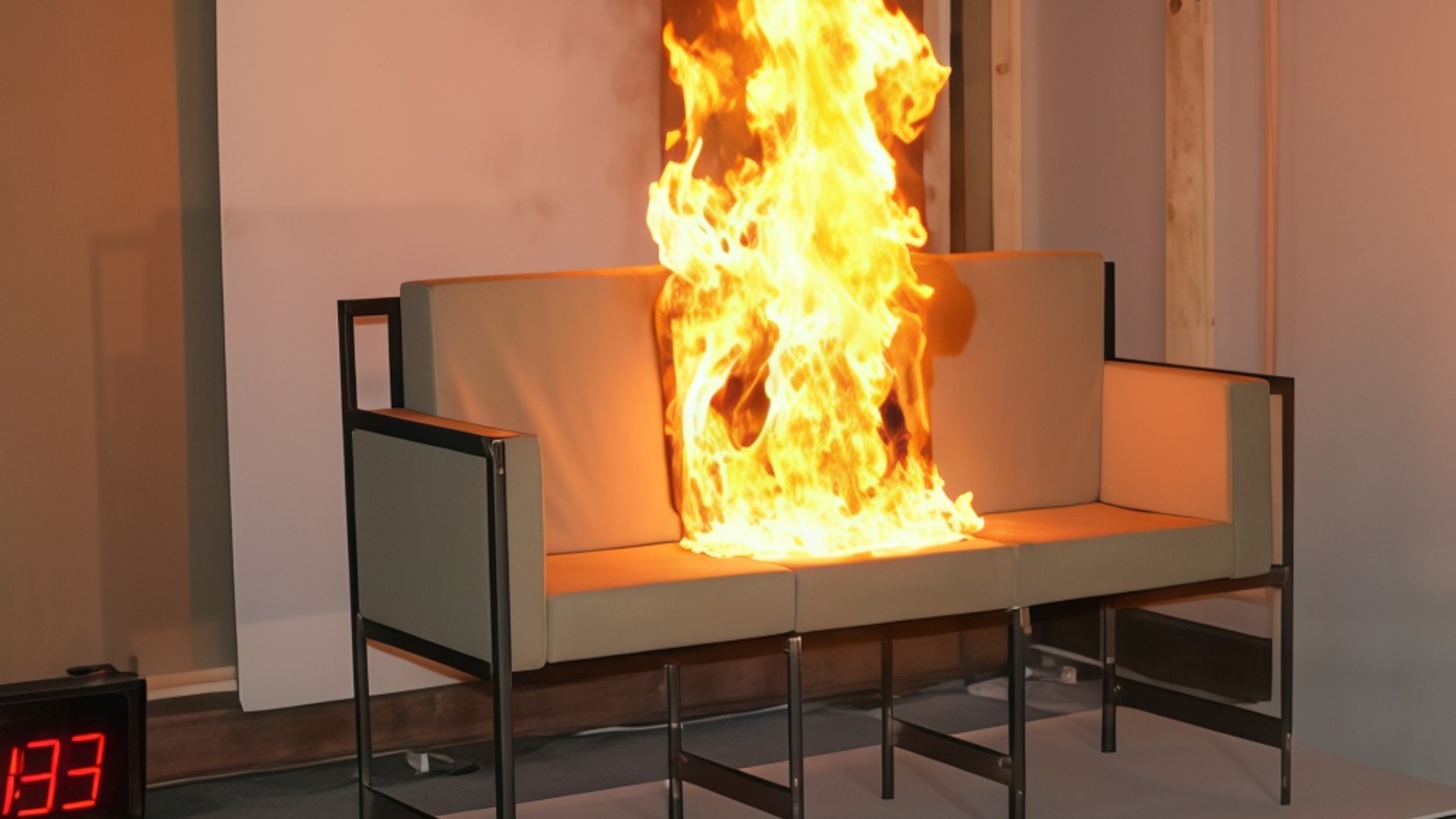
California Technical Bulletin 133 is the de facto standard for healthcare seating in the U.S., especially in California.
CAL 133 requires:
Open‑flame test on fully assembled seating (not just foam or fabric alone)
Maximum heat release rate: 80 kW
Total heat release: 25 MJ
No flaming droplets
Cost impact: Adds roughly ¥200–400 per chair in China. For orders over 200 pieces, specifying “CAL 133 foam formulation” as standard can lower per‑unit cost to around ¥120–200.
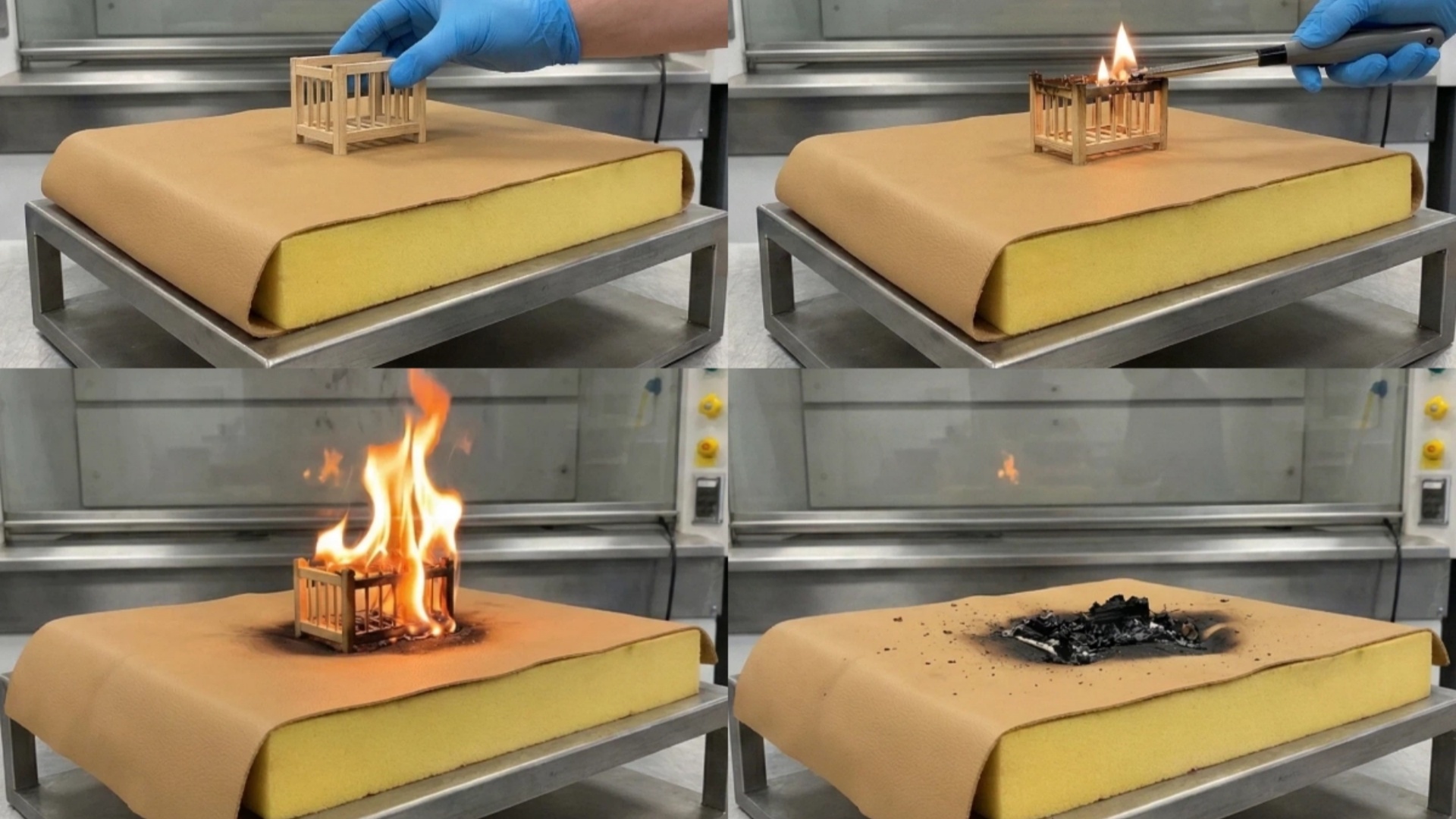
BS 7176 uses cigarette and match ignition sources to test upholstered composites.
“Source 5” is typically required for NHS and other healthcare contracts.
It tests the fabric‑foam assembly under match‑flame conditions.
The key difference from CAL 133 is that BS 7176 tests a composite under smaller ignition sources, while CAL 133 tests a fully assembled product with open flame. Both are rigorous; CAL 133 is closer to real fire scenarios.
Dubai and Abu Dhabi Civil Defense authorities have their own fire‑rating requirements for healthcare furniture materials.
They often require third‑party inspection of the manufacturing facility, not just product testing.
Lead time impact: You may need to add 4–6 weeks for Civil Defense factory audit before production can start.
Aligning your hospital furniture materials spec with the right local standard and audit process can save months of delay later.

Most material failures we see in healthcare furniture are not random; they follow the same patterns across projects.
The word “antimicrobial” has no precise regulatory definition in most furniture markets.
A fabric sprayed with a temporary treatment that lasts 10 washes and a silver‑ion infused fabric that lasts the life of the product can both be marketed as “antimicrobial.”
Fix: In your RFQ, specify the standard and required performance:
“Antimicrobial performance per ISO 20743 or ISO 22196, >99.9% reduction, third‑party test report (SGS/Intertek) required.”
A typical example is a U.S. hospital project that writes “CAL 133 compliant” in the spec but purchases from a China factory with only GB 17927 reports.
The factory may say “yes, compliant”—but it is compliant with GB 17927, not CAL 133.
Fix: Request test reports from an accredited lab that explicitly name the required standard in the report title and test method section.
Housekeeping staff in hospitals do not use gentle cleaners.
They typically use:
Quaternary ammonium at 2,000–5,000 ppm
Bleach at 500–1,000 ppm
Alcohol‑based hand sanitizers (70–90% ethanol or isopropyl)
Fix: Build chemical exposure into the material specification:
“Vinyl surface shall tolerate 5,000 cycles of 1,000 ppm sodium hypochlorite without visible degradation (per ISO 11998 or equivalent).”
Even the best antimicrobial fabric fails if seam construction creates a fluid pathway into the foam. Traditional needle‑stitched seams create micro‑channels that wick fluids inward.
Fix: For vinyl/PU hospital furniture materials, specify:
Heat‑sealed seams on all critical zones.
For woven fabrics (in lower‑risk areas), specify:
“Flat‑fell seams with antimicrobial thread (for example silver‑coated polyester).”
Small details like seams often determine whether seating survives 2 years or 7 years in real hospital use.
Hongye's healthcare furniture lines are built around hospital‑grade materials, not adapted from standard office or hospitality collections.
Key points of our healthcare furniture materials approach:
Silver‑ion infused vinyl used as standard (not just surface‑spray treatment).
All foams formulated in‑house with antimicrobial additive and density control.
Batch‑specific material test reports from SGS for each healthcare order, not just generic catalog reports.
CAL 133 and BS 7176 Source 5 testing performed per production run for critical seating lines.
Factory support for Middle East Civil Defense audits and documentation.
For each healthcare furniture project, our material specification pack includes:
Foam density certifications
Fabric antimicrobial test reports
Fire‑rating certificates (CAL 133 / BS 7176 / GB 17927)
Hardware corrosion‑resistance descriptions
All provided in one English document before production begins, so your clinical, procurement, and compliance teams can review and sign off.
If you share your current hospital furniture materials specification and target markets, we can review it against these three non‑negotiables and your local fire standards, and return a red‑flag summary within 48 hours to highlight infection‑control and durability risks.
Q1: What is the difference between “antimicrobial” and “antibacterial” in furniture fabrics?
“Antibacterial” usually refers to activity against bacteria such as S. aureus and E. coli.
“Antimicrobial” covers a broader range, including bacteria, fungi, and some viruses. For healthcare furniture materials, specifying true antimicrobial performance is more relevant to real‑world infection control.
Q2: How can we verify silver‑ion infusion versus surface treatment?
Ask for a cross‑section SEM (Scanning Electron Microscope) image of the fabric fibers and corresponding documentation.
Silver‑ion infusion appears as particles within the fiber matrix, while surface treatment appears as a coating on the fiber surface that washes off over 10–20 cleaning cycles.
Q3: Is CAL 133 required outside of California?
CAL 133 may not be legally required outside California, but many U.S. healthcare systems adopt it as a best‑practice standard.
For projects seeking LEED or WELL healthcare certification, CAL 133‑compliant seating is often a prerequisite or strongly recommended.
Q4: What is the expected life of healthcare vinyl versus PU “faux leather”?
In typical hospital use:
Healthcare vinyl (expanded PVC) with antimicrobial additive: about 7–10 years under daily cleaning.
PU “faux leather”: often 4–6 years.
The difference is mainly due to plasticizer stability; vinyl retains flexibility much longer under bleach exposure.
Q5: Can we get fire‑rated hospital furniture without chemical flame retardants?
Yes, by using inherently flame‑retardant fabrics (such as modacrylic or aramid blends).
However, these materials can cost 3–5× more than standard vinyl or PU. For most healthcare furniture procurement projects, the cost‑optimal approach is CAL 133 foam formulation plus high‑quality vinyl.


