Views: 0 Author: Site Editor Publish Time: 2026-01-26 Origin: Site


If you've ever walked into a state-of-the-art geriatric ward or a VIP suite at a hospital like the Saudi German Hospital, you’ve probably noticed something "off" about the chairs.
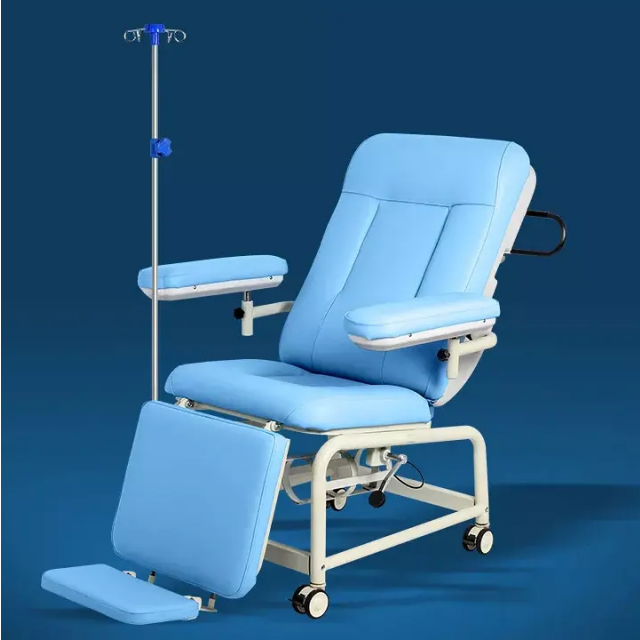
To the casual observer, they look ridiculous. While modern office chairs have sleek, T-shaped armrests that tuck neatly under desks, healthcare chairs have these long, oversized, slightly curved armrests that stick out like "Mantis Legs." They ruin the "clean lines" of the room. They look clunky. They look—dare we say it—"old."
In the industry, we hear the same complaint from interior designers all the time: "Can we just shorten the arms so the chair looks more modern?"
At Hongye (HY) Healthcare Furniture, our answer is usually a polite but firm: "No."
Because here is the "Cuck Chair" truth of medical design: If an armrest looks "sleek," it’s probably a fall hazard. Those "Mantis Legs" are actually a sophisticated piece of leverage physics and neurological feedback. Every extra inch of that armrest is a calculated response to the reality of human frailty.
This is the deep-dive into why the most "ugly" part of a chair is actually the most expensive and important piece of engineering in the room.
Standing up from a seated position is something a healthy 25-year-old does without thinking. For a 75-year-old with sarcopenia or a post-operative patient, it is a high-stakes mechanical maneuver.
To stand up, the human body must transition its Center of Gravity (CoG) from a stable, seated base to a narrow, standing base. This requires a massive burst of force from the quadriceps and gluteal muscles.
When a chair has short, "aesthetic" armrests, the patient is forced to perform a "Rocking Momentum" maneuver. They have to swing their torso forward to get their CoG over their feet. If they lack the core strength, they fail, falling back into the chair—an event known as a "Rebound Fall."
A medical-grade "Mantis" armrest solves this using the Principle of the Lever. By extending the armrest $2$ to $4$ inches past the edge of the seat cushion, we provide a Vertical Push-Point.
In physics terms, the torque ($T$) required at the knee joint is significantly reduced because the patient can use their upper body strength to create a downward force ($F$) further away from the pivot point.
$$T = F \cdot d \cdot \sin(\theta)$$
By increasing the distance ($d$) from the hip to the hand-placement, the patient reduces the mechanical load on the patellofemoral joint by up to 30% to 40%.
The Result: A patient who couldn't stand up alone in a "pretty" chair can now stand up independently in an "ugly" one. Independence isn't just a feeling; it's a calculation of force.
Why is the front of the armrest often rounded, thick, or "bulbous"? In the design world, we call this the "Grip End" or the "Secret Handshake."
When a patient is anxious or suffering from a neurological condition like Parkinson’s or severe Arthritis, their sense of "Proprioception" (the body's ability to sense its position in space) is diminished.
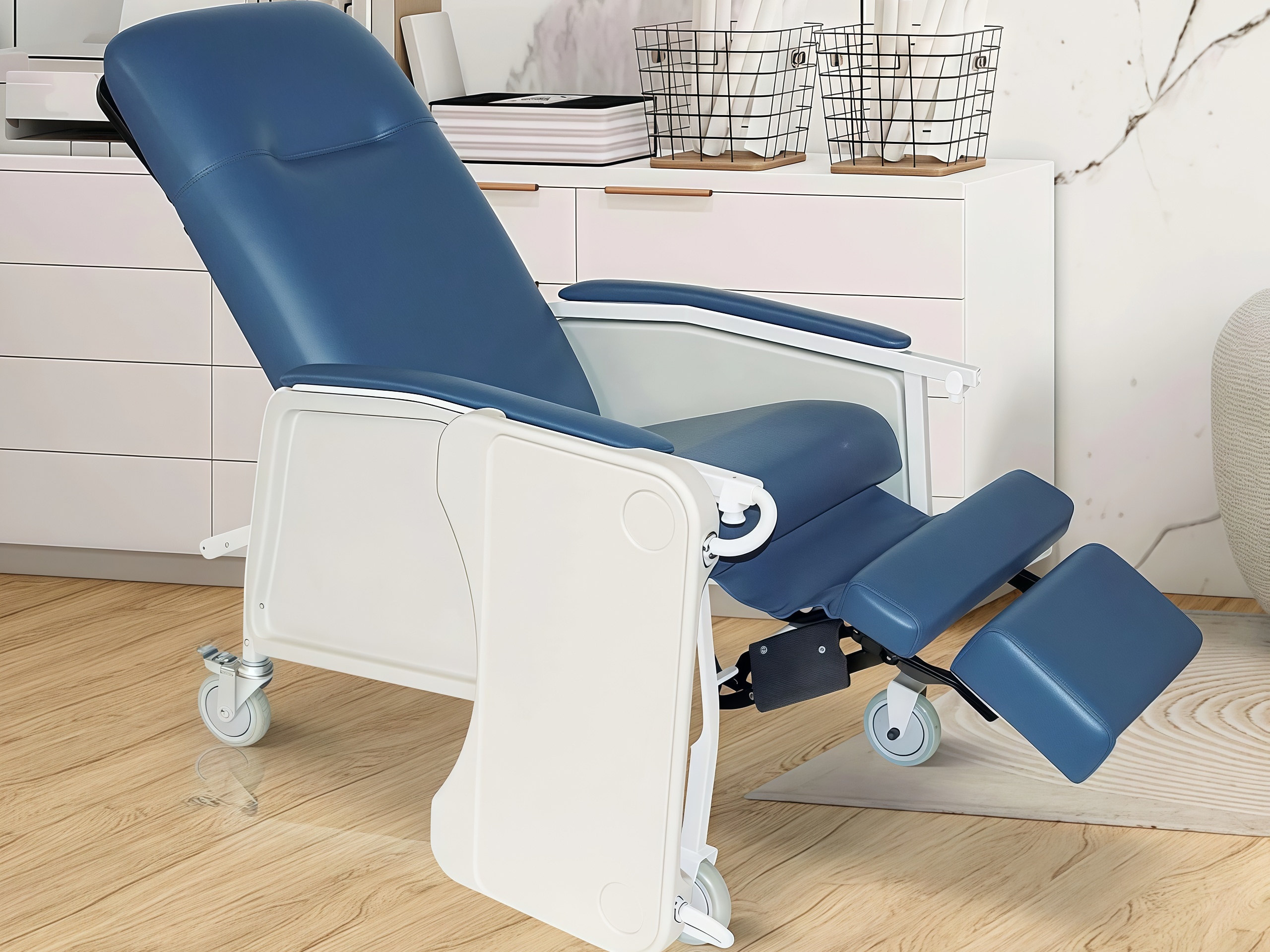
The "Bullnose" Curve: We engineer the front of the armrest with a specific diameter (usually between $1.5$ to $2$ inches) that mimics the natural "grip arc" of a human hand. This allows the patient to "hook" their fingers around the end.
Tactile Security: Before the patient even begins the sit-to-stand transition, they need to feel "locked in." A recessed armrest is invisible to someone with limited peripheral vision or mobility. A "Mantis Leg" is always there, right where the hand naturally falls.
Warm-Touch Materials: At HY Healthcare, we avoid cold stainless steel for grip points. We use high-performance, antimicrobial polymers that maintain a "room temperature" feel. Cold metal can cause a "startle response" or muscle tensing in geriatric patients, which increases the risk of a slip.
Hospitals are high-impact environments. Between $24/7$ cleaning crews, heavy meal trolleys, and emergency stretchers flying down hallways, furniture takes a beating.
If you look at our project for the Woodlands Health Campus in Singapore, the furniture isn't just sitting there—it’s acting as a structural bumper.
The reason those armrests stick out further than the seat is also protective.
1. Wall Protection: The armrest hits the wall before the seat back does. This creates a "standoff" zone that prevents the chair from scuffing expensive hospital paint or damaging drywall.
2. Impact Shielding: If a heavy stretcher or a wheelchair clips the chair, the armrest—which is reinforced with a heavy-gauge steel internal skeleton—takes the hit. This prevents the impact from reaching the patient’s hips or the chair's upholstery, which is much more expensive to repair.
The Engineering Standard: We test these armrests to ANSI/BIFMA X5.4 standards. This involves a "Hammer Test" where a weighted pendulum strikes the armrest thousands of times. If a designer armrest takes that hit, it snaps. An HY armrest doesn't even flinch.
In the Saudi German Hospital Makkah project, the challenge was to provide 5-star luxury for VIP suites without compromising on these "Mantis Leg" safety features.
The Solution:
We utilized Heat-Transfer Aluminum that perfectly mimics the look of premium walnut wood. To the patient, the armrest looks like a piece of handcrafted furniture. But underneath that wood-grain finish is a high-tensile metal alloy capable of supporting a static load of 500 lbs ($226$ kg) on a single armrest.
The patient feels they are in a hotel; the hospital knows they are in a high-safety environment. This is the "Medical Hospitality" crossover that Hongye (HY) excels at.
Internal Link: Explore the SGH Makkah VIP Furniture Solution


Is it worth paying $1,500 for a chair with "Mantis Legs" when a "Contract" chair costs $400? Let’s look at the actuarial data.
According to the CDC (Centers for Disease Control and Prevention), the average medical cost for a fall-related injury in an elderly patient is over $30,000, rising to $50,000+ if surgery is required.
Feature | Cheap "Contract" Chair | HY Healthcare "Mantis" Chair |
Armrest Length | Short (Recessed) | Extended (Leverage Point) |
Sit-to-Stand Assist | Zero | 30% Force Reduction |
Joint Stress | High (Risk of failure) | Low (Guided transition) |
Weight Capacity | 250 lbs | 1,000 lbs (Bariatric Rated) |
Life Cycle Cost | Replace every 2 years | Replace every 15 years |
If that "ugly" armrest prevents even one fall over its 15-year lifespan, it has paid for itself 20 times over. Furthermore, consider the Worker’s Comp factor. When a chair assists a patient in standing, the nursing staff doesn't have to lift them. Back injuries among nurses are the #1 cause of lost workdays in hospitals. Our armrests don't just protect the patient; they protect your most valuable asset: your staff.
In the world of high-performance healthcare, "beauty" is defined by Zero-Failure.
A chair that looks like a "Mantis" is a chair that respects the patient's struggle. It is a chair that understands the physics of aging. It is a chair that says, "I will not let you fall."
At Hongye (HY) Healthcare Furniture, we have spent decades perfecting the "Secret Handshake" between the human body and the medical environment. From our $500,000$ square-meter manufacturing base, we ship these "ugly" masterpieces to the most prestigious hospitals in the world.
Because in the end, the most beautiful thing in a hospital isn't a chair. It's a patient who can stand up on their own, with dignity, and walk out the front door.