
Views: 0 Author: Site Editor Publish Time: 2026-02-13 Origin: Site


Medical falls are the leading cause of injury among seniors, with over 36 million falls reported annually in elderly care environments. While floor surfaces and lighting are often blamed, the physical interface between the resident and their furniture is the most critical factor in fall prevention. For facility managers and compliance officers, selecting fall prevention furniture is not just about comfort—it is a clinical intervention.

This guide analyzes the "Golden Heights" of seating, the physics of stability, and the latest ADA-compliant standards for 2026.
The transition from sitting to standing is the moment of highest risk. If a chair is too low, the senior lacks the quadriceps strength to propel upward; if it is too high, their feet may not touch the floor, leading to instability.
Research indicates that the optimal seat height for elderly residents is generally between 18 and 20 inches. This allows for a 90-degree knee angle, ensuring the center of gravity remains balanced.
Firmness Matters: A seat that is too soft will "bottom out," effectively lowering the seat height by 2–3 inches and trapping the resident.
Armrest Leverage: ADA-compliant senior seating must feature extended, easy-to-grip armrests that provide a stable platform for the resident to push off from.

Standard residential furniture often tips when weight is applied to the edge. In a healthcare setting, stability is non-negotiable.
Anti-Tip Bases: Look for chairs with a wider "footprint" where the legs extend slightly beyond the seat perimeter.
Weighted Frames: High-quality fall prevention furniture often utilizes reinforced steel or solid hardwood frames to ensure the unit doesn't slide when a resident "flops" into the seat.
Wall-Saver Designs: These mechanisms ensure that as a chair reclines, the center of gravity remains centered over the base, preventing rear-tip accidents.
Feature | Standard Furniture | Fall Prevention Furniture |
Leg Construction | Tapered/Aesthetic | Reinforced/Wide-Base |
Seat Density | Low-density foam | High-resiliency (HR) medical foam |
Armrest Length | Short/Recessed | Full-length (Extended) |
Weight Capacity | 250 lbs | 350 lbs - 600 lbs (Bariatric) |
To help facility managers meet safety quotas, we have curated a list of top-tier furniture solutions engineered specifically for stability and safe egress.
Safety Highlight: Features a Forward-Tilt Assist mechanism that gently nudges the seat base upward as the resident begins to stand, reducing the strain on hip joints.
Stability Factor: Equipped with an ultra-wide steel base and a "wall-saver" recline path to ensure the chair's center of gravity remains centered.
Best For: Residents with moderate mobility limitations in private patient rooms.
Safety Highlight: Designed with Full-Length Armrests that extend past the seat edge, providing a firm surface for the resident to grip until they are fully upright.
Stability Factor: Anti-tip leg glides and a weighted solid wood frame that prevents the chair from sliding backward during a seated "drop."
Best For: Communal dining areas and activity rooms.
Safety Highlight: Lowers to a industry-leading 7-inch clearance from the floor, virtually eliminating the risk of injury from bed rolls.
Stability Factor: Features a "One-Touch" central locking system that secures all four casters simultaneously, ensuring a rock-solid platform for bed transfers.
Best For: Memory care units and residents with high fall-risk scores.

Safety Highlight: A reinforced internal steel structure rated for 600 lbs, ensuring that the seat height does not "sink" or deform under heavy loads.
Stability Factor: Extra-wide stance and non-slip rubberized feet designed for high-traffic common areas.
Best For: Bariatric care and inclusive common area seating.
Safety Highlight: Unlike standard tables that can slide away if a resident leans on them for support, this model features Pressure-Locking Casters that freeze in place when downward weight is applied.
Best For: Bedside dining and laptop use, providing an accidental "grab bar" for residents.
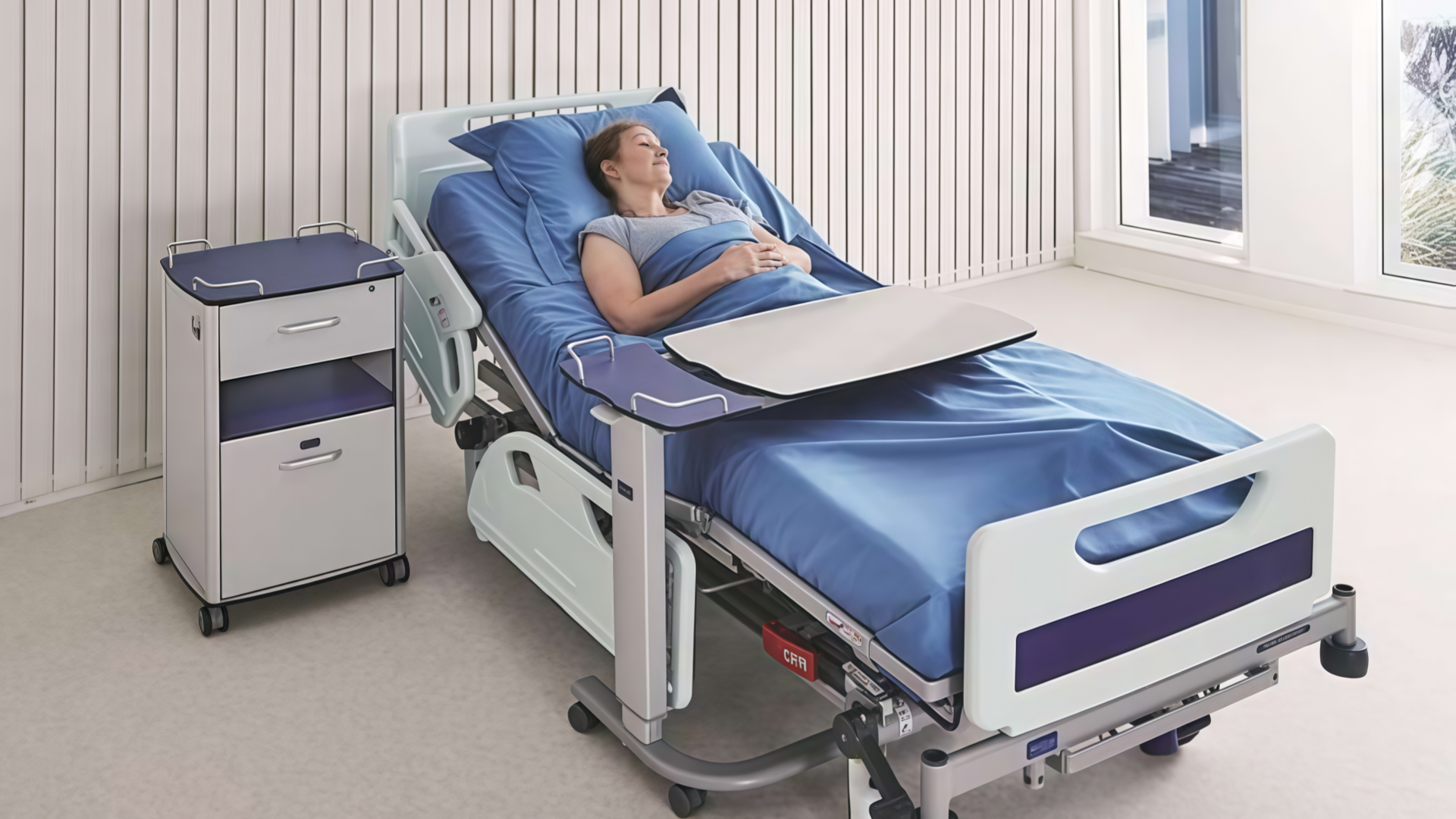
Bed-related falls often occur during "unassisted egress" at night. Modern safe exit nursing home beds are engineered to mitigate this risk through height adjustability and integrated technology.
Modern medical beds can now lower to as little as 7 inches off the floor. This "floor-level" positioning ensures that if a resident does roll out of bed, the impact force is significantly reduced, preventing fractures.
By 2026, the industry standard has shifted toward sensor-integrated furniture:
Under-Bed Lighting: Motion-activated LED strips that illuminate the floor path as soon as a resident's feet touch the ground.
Egress Alarms: Real-time alerts sent to nurse stations when a high-risk resident attempts to exit the bed without assistance.
Fall prevention is only effective if the furniture remains in peak condition. Compliance officers should implement a Quarterly Stability Audit.

Fastener Integrity: Check all bolts and joints for "wobble" or loosening.
Caster Locks: Ensure that locking mechanisms on mobile recliners engage fully and do not slip under pressure.
Upholstery Friction: Inspect for overly slick surfaces. Worn-out vinyl can become slippery, causing residents to slide forward out of the chair.
Expert Note: Always document your maintenance logs. In the event of a state survey or audit, proving a "Preventative Maintenance Schedule" for your furniture can protect your facility from liability.
While the ADA specifies 17"–19" for public toilets, senior care experts recommend 18"–20" for lounge seating to account for the physical decline in leg strength among residents.
Yes. Gravity-link mechanisms allow the resident to recline using their own body weight without struggling with hard-to-reach levers, which can often cause a resident to lean dangerously to one side.
If the chair must be moved frequently, use medical-grade locking casters. For static seating in common areas, use non-slip nylon glides to ensure the chair stays anchored during sit-to-stand movements.
Investing in fall prevention furniture is a proactive strategy to improve resident outcomes and reduce facility liability. By focusing on the "Golden Height" and prioritizing structural stability, healthcare providers can create an environment that fosters independence rather than fear.


