
Views: 0 Author: Site Editor Publish Time: 2026-04-24 Origin: Site


Behavioral healthcare design trends have moved from niche conversations to board‑level priorities for hospitals, health systems, and growing outpatient networks. Today's decision‑makers are under pressure to expand capacity, improve safety, retain staff, and deliver better outcomes, often within constrained capital budgets. In this context, understanding behavioral healthcare design trends for modern facilities is no longer optional; it is central to strategic planning for healthcare architects and clinic owners.

Across many markets, behavioral health utilization has grown by an estimated 20–30% over the past decade, with higher patient acuity and more complex co‑occurring conditions. At the same time, organizations face workforce shortages and burnout, alongside heightened expectations around ligature risk mitigation, infection control, and patient experience. That is why many teams are turning to evidence‑based behavioral healthcare design trends with safety focus, integrating architecture, interior design, and furniture selection into one coordinated response.
This article unpacks the most important behavioral healthcare design trends for project planning and translates them into practical, buildable strategies. The aim is to help you make informed choices—about layout, finishes, and behavioral healthcare design trends furniture solutions—that are clinically sound, operationally efficient, and financially sustainable.
In many regions, demand for behavioral health services is growing faster than physical capacity. Emergency departments see more behavioral health presentations; inpatient units run at sustained high occupancy; and communities push for more crisis and step‑down facilities. As a result, behavioral healthcare design trends for high‑acuity units are influenced as much by throughput and staff workflow as by classic spatial metrics like bed count.
Clinical models are also changing. Behavioral health is increasingly integrated with primary and specialty care, leading to hybrid clinics where a single floorplate must support urgent assessments, scheduled therapy, and telehealth within a relatively small footprint. In this context, design trends are driven by both operational efficiency and clinical safety—from how decentralized nurse stations function, to how behavioral healthcare design trends exam rooms support multiple visit types in a day.
At the same time, codes and guidelines have matured. Many accrediting bodies now expect formal ligature risk assessments, trauma‑informed design considerations, and post‑occupancy evaluations. Rather than focusing only on “do no harm,” behavioral healthcare design trends for recovery‑oriented environments aim to support dignity, autonomy, and community connection. Designers and owners are therefore moving beyond purely institutional models toward spaces that look and feel more like real homes, schools, and workplaces—while still meeting strict safety criteria.
One of the most visible behavioral healthcare design trends is the shift away from custodial, institutional aesthetics. Historically, many facilities resembled secure wards, with hard finishes, harsh lighting, and minimal personalization. That approach often increased stigma, reinforced power imbalances, and made staff work in environments that felt more like correctional facilities than places of healing.
Today, leading projects adopt behavioral healthcare design trends for homelike atmospheres, introducing elements such as residential‑style lighting, wood‑tone finishes, and soft color palettes. Furniture is carefully chosen to feel familiar without compromising safety: seating lines resemble contemporary living rooms, casegoods echo hotel‑style storage, and dining areas mirror community cafés. Where appropriate, this is reinforced with artwork, views to nature, and varied seating options that support both social interaction and quiet reflection.
These strategies must be tuned to project type. Inpatient units typically need a higher proportion of fixed, ligature‑resistant solutions than outpatient clinics, but both can benefit from normalized aesthetics. Crisis centers and behavioral health pods within general hospitals often act as a patient's first contact point, so the first few minutes of spatial experience—arrival, reception, waiting—are critical to reducing anxiety and communicating respect.


Another major driver of behavioral healthcare design trends is uncertainty. Service lines, reimbursement models, and patient profiles can change significantly over a facility's 15–25‑year life. As a result, many teams are planning for “unknown future programs,” prioritizing flexibility over ultra‑specialized layouts.
Universal rooms—spaces that can flex between step‑down, observation, and standard inpatient use—are one response. They may be sized to accommodate different bed types, with infrastructure in place for higher‑acuity monitoring even if not immediately used. Swing spaces between units add another layer of resilience, enabling a cluster of rooms to shift between adolescent and adult use, or between behavioral and medical observation, as demand changes.
On the communal side, multipurpose group rooms support therapy, staff training, family meetings, and community outreach at different times of day or week. Here, behavioral healthcare design trends flexible seating solutions and movable partitions matter: furniture systems must be robust, tamper‑resistant, and easy for staff to reconfigure without specialist tools. Infrastructure also plays a role—ceiling grids, lighting layouts, and technology provisions should support space reconfiguration without requiring major demolition.
Safety remains the non‑negotiable foundation of any behavioral healthcare project. However, one of the most important behavioral healthcare design trends safety integration has been the shift from overtly “security‑first” environments to spaces that quietly embed ligature‑resistant and trauma‑informed features. The goal is to maintain robust safety while avoiding carceral cues that can re‑traumatize patients or increase agitation.
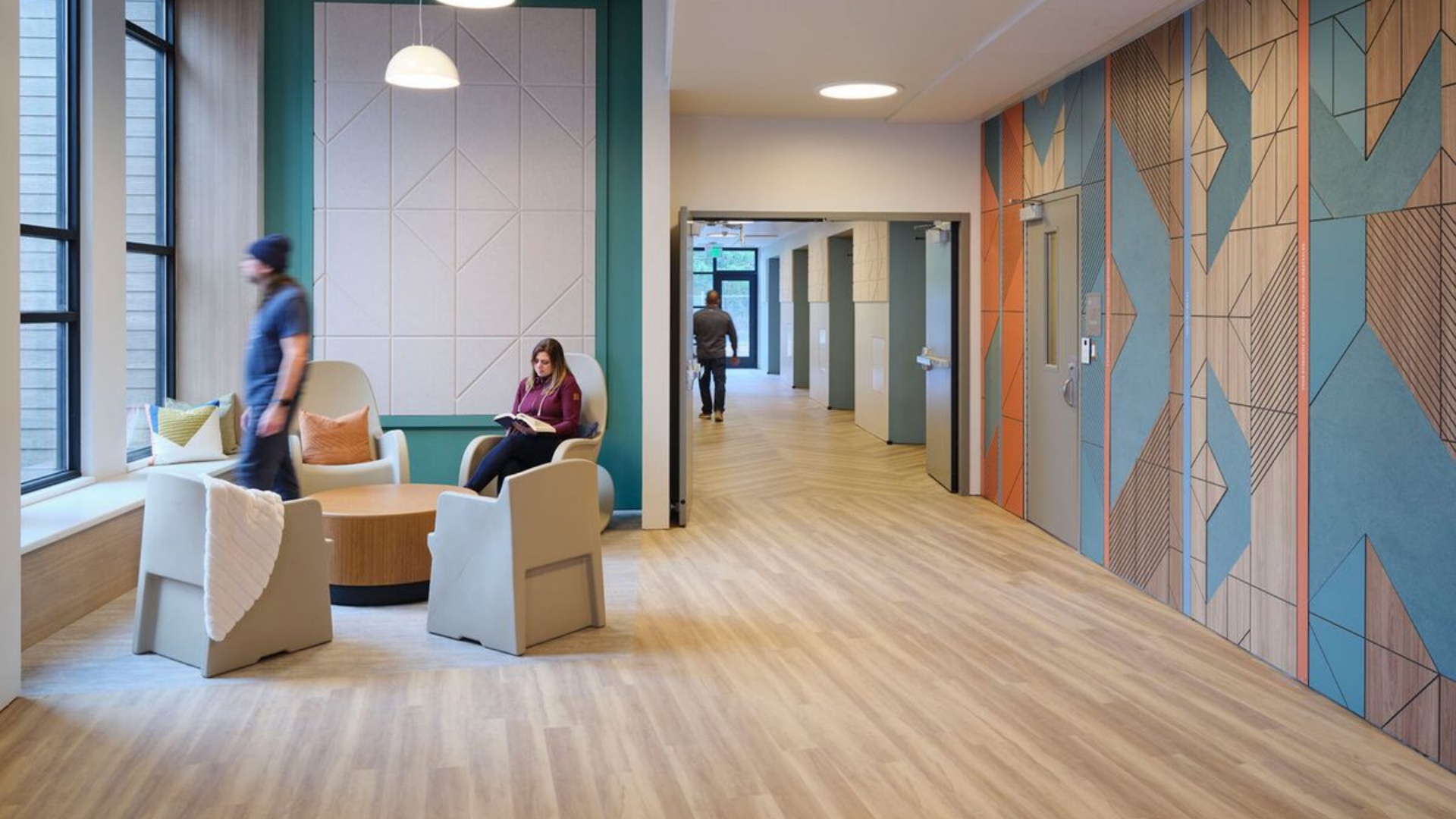
Integrated anti‑ligature design
Instead of scattering obviously institutional devices throughout a unit, designers now select ligature‑resistant fixtures, hardware, and behavioral healthcare design trends furniture systems that share a coherent aesthetic. Handles, grab bars, and casework pulls are chosen not just for performance but also for how they align with the wider design language, reducing visual clutter and “security theater.”
Clear sightlines and zoning
Modern floorplans emphasize open sightlines between staff bases and patient areas, minimizing blind spots and reducing the need for intrusive spot checks. Decentralized care stations bring staff closer to patients, while thoughtful zoning separates high‑stimulus areas (e.g., active day rooms) from quiet zones. This spatial clarity supports both safety and patient orientation.
Trauma‑informed layout and details
Trauma‑informed behavioral healthcare design trends emphasize predictability, clarity, and choice. Circulation paths are logical and easy to understand; entry sequences avoid sudden confrontations or crowded bottlenecks; and thresholds between public, semi‑public, and private zones are clear. Micro‑details—like avoiding fully mirrored surfaces, using warm rather than glaring light, and providing visual access to exits—help reduce anxiety and perceived entrapment.
Choice, control, and privacy
Research suggests that providing safe choices can de‑escalate distress and support recovery. Design responses include varied seating types (from lounge chairs to benches and high‑back single seats), options for social and solitary time, and quiet rooms where individuals can regulate their own sensory input. These are framed within clear observation strategies so that privacy does not come at the expense of safety.
Noise control and sensory regulation
Acoustic treatment is now a standard topic in behavioral healthcare design trends acoustics discussions. Designers deploy high‑performance ceilings, wall panels, and floor finishes to reduce reverberation, supplemented by careful equipment selection to minimize mechanical noise. Many facilities also designate low‑stimulus rooms with controllable lighting and sound environments, supporting de‑escalation for patients with heightened sensory sensitivity.
Evidence continues to show that access to nature, daylight, and carefully curated sensory experiences can reduce stress, improve mood, and support staff resilience. In response, behavioral healthcare design trends for biophilic environments have moved from small “green touches” to integrated systems.
Typical biophilic strategies include secure outdoor terraces for inpatient units, interior courtyards with controlled access, and patient paths that intentionally pass by windows with views of planted areas. Where direct outdoor access is limited, designers may incorporate large‑scale imagery of nature, natural materials like wood and stone, and color palettes inspired by local landscapes.
Sensory‑responsive design goes a step further by adjusting lighting, sound, and visual complexity for diverse populations. Adjustable white‑tuning lighting allows staff to modulate color temperature to support circadian rhythms, while layered lighting schemes offer indirect, dimmable options to avoid glare. For neurodivergent populations or those with trauma histories, controlling visual clutter—through integrated storage, simplified signage, and carefully chosen patterns—can make spaces feel less overwhelming.

Behavioral healthcare design trends technology integration are being reshaped by telehealth, remote monitoring, and data‑driven care coordination. Since 2020, many providers report that 20–40% of behavioral health visits include a virtual component at some stage of treatment, and physical environments must adapt.
Private telehealth pods or small consult rooms are becoming a standard part of clinics and inpatient units. These spaces require robust acoustic separation, secure data infrastructure, and lighting that reads well on camera while remaining comfortable for patients. Exam and consult rooms may be designed as hybrid environments, with infrastructure for in‑person assessment, teleconsultation, family conferencing, and interdisciplinary team meetings.
Back‑of‑house spaces are also evolving. Behavioral healthcare design trends for digital operations include dedicated rooms for virtual care teams, centralized monitoring hubs, and flexible touchdown spaces for clinicians who split their time between physical and virtual work. Designers must consider privacy regulations, cyber‑security infrastructure, backup power, and ergonomic workstation layouts to ensure technology supports rather than disrupts therapeutic relationships.
Even the best behavioral healthcare design trends concept will fail if it does not align with real‑world operations. Successful projects start with structured collaboration between architects, clinicians, operations leaders, patients, and families. Co‑design workshops, simulation exercises, and scenario planning can reveal friction points long before construction begins.
Programming and operational modeling help test design ideas—such as unit size, bed mix, decentralized vs. centralized staff bases, and storage strategies—against staffing levels and clinical workflows. For example, a unit designed around 12‑bed pods with decentralized nurse stations may reduce walking distances and improve visibility, but only if staffing ratios and supervision models support that configuration. Aligning these factors early reduces the risk of “beautiful but unworkable” environments.
Long‑term operational resilience is another key driver. Behavioral healthcare design trends resilience focus on staff wellness, maintainability, and phased growth. Decisions around materials, mechanical systems, and behavioral healthcare design trends furniture durability should consider 8–15‑year replacement cycles, not just first cost. Similarly, clear expansion strategies—like shelled space or service‑ready risers—can prevent expensive disruptions when service lines grow or shift.
Moving from abstract behavioral healthcare design trends to built environments requires a practical roadmap. The following high‑level steps can guide both new construction and renovation projects.

Prioritize based on acuity, risk, and strategic goals
Start by mapping current and projected demand, acuity profiles, and risk hot spots. Use this analysis to decide where to invest first: for example, upgrading high‑risk inpatient bathrooms and day rooms before lower‑risk administrative areas.
Pilot trend‑informed solutions in targeted areas
Rather than rolling out every new idea across an entire campus, many organizations test specific trends in a pilot unit or clinic. This allows them to evaluate how behavioral healthcare design trends flexible seating, lighting, or zoning perform in practice, and adjust before scaling.
Build feedback loops and continuous improvement
Post‑occupancy evaluations, staff and patient surveys, incident analysis, and environmental data (e.g., occupancy, noise levels) should feed back into future design decisions. Over time, this creates a virtuous cycle where each project refines the organization’s internal standards and “toolkit” of proven solutions.
To support decision‑making, it can be useful to summarize key options and their characteristics in a simple table during early planning, as shown below.
| Parameter / Option | Description |
Normalized vs. institutional aesthetic | Choice between homelike finishes vs. high‑visibility “institutional” cues; most projects now favor normalized aesthetics with embedded safety. |
Fixed vs. flexible room typologies | Fixed layouts suit stable programs; flexible/universal rooms better for evolving acuity and hybrid care models. |
Basic vs. enhanced biophilic strategies | Basic: daylight and limited views; enhanced: courtyards, terraces, extensive natural materials and imagery. |
Minimal vs. fully integrated technology | Minimal supports basic telehealth; full integration enables hybrid care, centralized monitoring, and digital collaboration. |
This type of structured comparison helps stakeholders understand trade‑offs, align around priorities, and justify investments to boards or funders.
Contemporary behavioral healthcare design trends are about much more than visual updates. They represent a shift toward environments that align safety, dignity, flexibility, and therapeutic effectiveness. By combining normalized aesthetics, anti‑ligature and trauma‑informed strategies, biophilic and sensory‑responsive design, and technology‑ready infrastructure, architects and clinic owners can create spaces that support both clinical outcomes and human experience.
For healthcare architects and clinic owners, these behavioral healthcare design trends for strategic planning offer a framework for more resilient, person‑centered projects—whether you are designing a small outpatient clinic, a crisis stabilization center, or a full behavioral health campus. The key is to translate trends into specific, testable decisions about layout, materials, technology, and behavioral healthcare design trends furniture solutions that match your population, workforce, and budget.
Hongye Furniture positions itself as an industry leader in behavioral healthcare environments, offering integrated furniture ranges that support anti‑ligature safety, normalized aesthetics, and long‑term durability. By partnering with a specialist supplier that understands behavioral healthcare design trends and operational realities, you can reduce project risk, streamline specification, and deliver interiors that perform over time.
As a next step, consider engaging Hongye Furniture to review your upcoming behavioral health projects, request detailed product specifications and case studies, or download a dedicated design guide that expands on the topics in this article. Whether you are planning a pilot renovation or a new flagship facility, aligning with experienced partners who prioritize safety, compliance, and social responsibility will help you deliver environments where patients, families, and staff can truly thrive.


