
Views: 0 Author: Site Editor Publish Time: 2026-01-30 Origin: Site


If you've ever been stuck in a hospital bed, you know the overbed table is your entire world. It’s your dining table for lukewarm soup, your desk for a tablet, your pharmacy for daily meds, and—frequently—the place where a nurse sets down a used cotton ball or a wound-dressing kit.
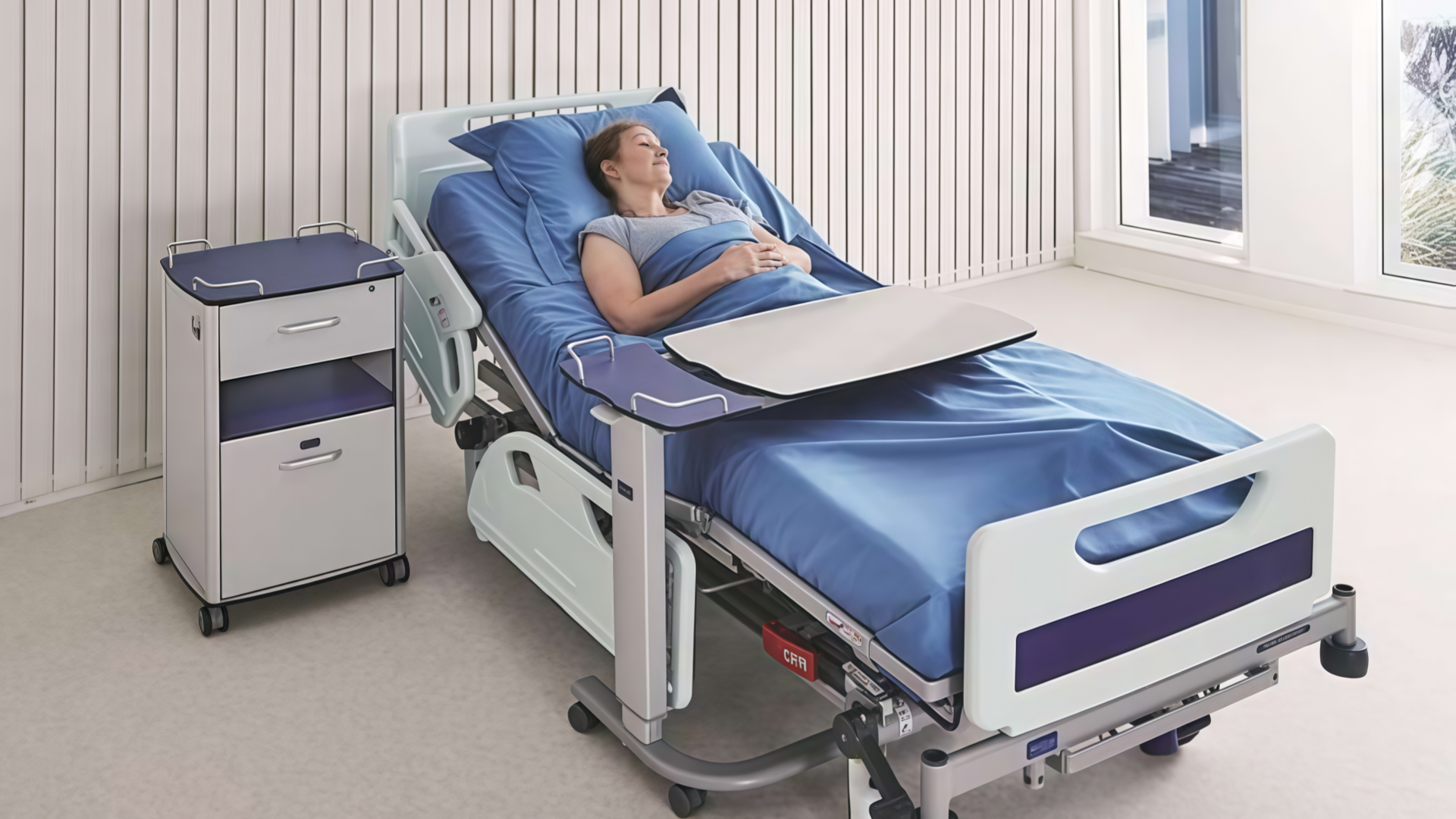
To the casual observer, it's just a piece of plastic on wheels. But to a microbiologist, an improperly designed overbed table is a Biological Time Bomb.
In the viral world of furniture memes, we talked about the "Cuck Chair." In the world of healthcare, we need to talk about the "Petri-Dish Desk." While most hospitals spend millions on HEPA filters and robotic surgery, they often settle for "contract-grade" tables that are literally designed to breed superbugs.
At Hongye (HY) Healthcare Furniture, we don't look at a table as "furniture." We look at it as a barrier in a microscopic war. Here is why the table you’re eating off of might be the most dangerous object in the room—and how "hardcore" engineering is the only way to defuse the bomb.
Let's start with a reality check that would make most people lose their appetite.
According to the CDC (Centers for Disease Control and Prevention), on any given day, about 1 in 31 hospital patients has at least one healthcare-associated infection (HAI). A significant portion of these infections is spread via "High-Touch Surfaces."
The overbed table is the king of high-touch surfaces. It is touched by the patient, the nurse, the doctor, and the visitors—often hundreds of times a day.
Most "budget" overbed tables are made of wood or composite board with a PVC "edge band" glued around the side. It looks fine on Day 1. But by Day 100, the constant cleaning with harsh chemicals causes that glue to degrade.
This creates a microscopic gap—a "Glue Line." This gap is too small for a cleaning wipe to reach, but it is a Grand Canyon for MRSA (Methicillin-resistant Staphylococcus aureus). The HY Difference: Monolithic Engineering
We don't use glue. We use Monolithic Injection Molding. Our tabletops are one single, solid piece of non-porous polymer. There are zero seams. Zero cracks. Zero places for a "Biological Time Bomb" to tick. When you wipe a HY table, you are cleaning $100\%$ of the surface, not $98\%$.
In a hospital, a spill is never just a spill. If a patient knocks over a glass of water, it’s a slip hazard. If they knock over a basin of fluids from a medical procedure, it's a bio-hazard event.
Most overbed tables are flat. When liquid hits a flat surface, gravity takes over. The liquid flows off the edge, onto the bedsheets (requiring a full linen change), or onto the floor (creating a fall risk for the next person who walks in).

At Hongye, we engineered our table edges with a specific Spill-Containment Ridge.
Through fluid dynamics testing, we calculated the height and tension required to contain up to $500$ ml of liquid.
The Physics: By utilizing surface tension and a perimeter "lip," we ensure that gravity is defeated.
The ROI: One spill contained by the table saves a hospital approximately $180$ in laundry costs, $45$ minutes of nursing time, and potentially $50,000$ in liability if a staff member avoids a slip-and-fall.
Hospitals don't clean; they decontaminate. They use "hospital-grade" disinfectants—often high concentrations of bleach, hydrogen peroxide, or quaternary ammonium.
If you use a residential-grade laminate table, these chemicals will cause the surface to "ghost," crack, or peel within months. Once a surface is cracked, it can no longer be sterilized. It's game over.

We use Medical-Grade ABS and High-Pressure Laminates (HPL) that are chemically inert.
ISO 22196 Compliance: Our surfaces are treated with silver-ion antimicrobial agents that actively destroy the cell walls of bacteria.
The 10-Year Surface: While a cheap table "yellows" and becomes brittle, our materials are UV-stabilized and chemical-resistant, ensuring the table remains non-porous for over a decade of heavy decontamination.
A patient in a hospital bed is often at their weakest. They may have an IV in one arm, limited mobility, or post-operative pain. If they need to move their table and the mechanism is "sticky" or requires a manual screw-knob, they won't move it. They will wait for a nurse.
We integrate Gas-Assist Spring Technology into the column of the table.
The Force Calculation: It takes less than $5$ Newtons of force to raise the table. A patient can literally use one finger to adjust their environment.
Staff Efficiency: Every time a patient can adjust their own table, it's one less "Nurse Call." In a $500$-bed hospital, this translates to hundreds of hours of saved clinical time per year.
When the Saudi German Hospital in Makkah designed their VIP and standard wards, they didn't just want "tables." They wanted an infection-control strategy.
The HY Solution:
We provided monolithic, spill-containment overbed tables that passed the Joint Commission International (JCI) audit with flying colors. By eliminating the "Glue Line" and providing a chemical-resistant surface, we helped them create a ward that isn't just luxurious—it's biologically secure.
Internal Link: How Hongye Furnished the Saudi German Hospital Makkah

Feature | Cheap "Contract" Table | HY Medical-Grade Table |
Surface | PVC Edge-banded (Seams) | Monolithic Injection Molded (Seamless) |
Spill Control | None (Liquids hit the floor) | 500ml Containment Ridge |
Adjustment | Manual Knobs / Friction | Gas-Spring (One-Handed) |
Antimicrobial | Surface-only spray | Integrated Silver-Ion Technology |
Lifespan | 1–2 Years | 10+ Years |
The "Biological Time Bomb" teaches us that healthcare furniture has a clinical consequence.
A table that is "pretty" but porous is a liability. A table that is "sleek" but has seams is a home for bacteria. At Hongye (HY) Healthcare, we believe that the ultimate luxury in a hospital is Safety.
When you invest in a HY overbed table, you aren't just buying a place for a tray. You are defusing a bomb. You are choosing a piece of engineering that protects the patient, empowers the staff, and secures the facility's reputation.
Stop serving lunch on a bio-hazard.


