|


loading


| Color: | |
|---|---|
| Material : | |
| Seat Height: | |
| Dimension: | |
| Availability: | |
| Quantity: | |
Cuboc

Experience effortless mobility with our medical rolling stool's smooth and noise-free rolling capabilities.
The heavy-duty nylon caster wheels are designed to glide seamlessly on all types of floors, allowing you to move around your dental or hospital workspace with ease.
With reliable and silent rolling, you can focus on your tasks without any distractions or disruptions, ensuring optimal productivity and efficiency.

With a range from 24.5" to 31", you can easily find the perfect height that suits your comfort and ergonomic needs.
Whether you need to attend to patients or perform delicate laboratory procedures, our adjustable height rolling stool provides the flexibility to adapt to different workstations and tasks.
Achieve optimal posture and reduce the risk of strain by effortlessly adjusting the chair to your desired height.

Engineered to correct your posture, the unique saddle-shaped dental seat promotes a straight and upright position, reducing stress on your neck and back.
The contoured seat cushion provides exceptional comfort and evenly distributes your body weight, allowing you to sit for longer periods without discomfort.
Embrace the benefits of our saddle-shaped chair and experience improved comfort and support during your dental or hospital work.

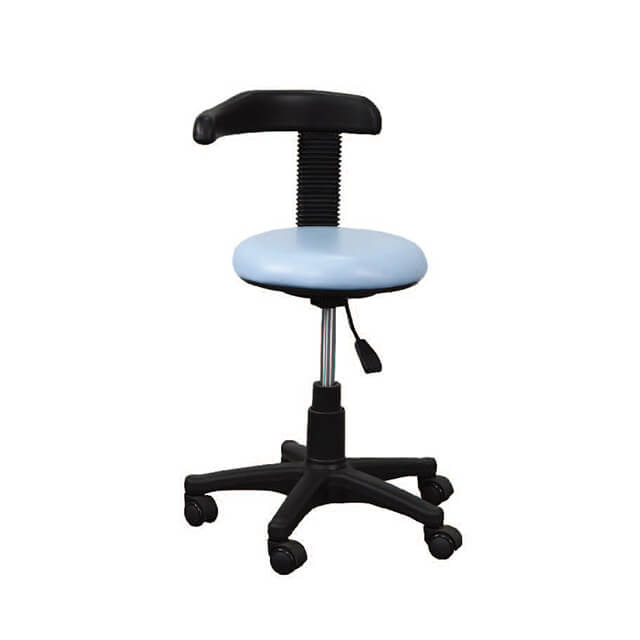
Our rolling saddle stool with back support is crafted with superior materials to ensure durability and comfort.
The sturdy aluminum legs offer stability and long-lasting performance, providing a solid foundation for your seated tasks.
The generous padding of the leather seat delivers plush and supportive cushioning, enhancing your overall sitting experience.
The chrome base with PU casters not only adds a touch of style but also enables smooth and effortless movement, making it easy for you to navigate your dental or hospital workspace.

The dual swivel casters enable easy movement and provide extra stability, allowing you to navigate your dental or hospital environment effortlessly.
The soft polyurethane wheels are specifically designed to protect delicate flooring surfaces, ensuring a smooth and silent glide without causing any damage.
With our chair's exceptional mobility features, you can confidently focus on your dental or hospital tasks, knowing that you can move around with ease and precision.

A pharmacy dispensary counter is three work surfaces in one run: a bench where prescriptions are filled, a bench where they are checked, and a face where they are handed over. Plan it by task and in one direction (fill, check, hand over), with heights, storage positions and clear floor space dimensi

Specify a nurse station around the shift. That means a split-level worktop for standing and seated tasks, storage placed by how often items are used, and surfaces and joints that can be wiped in one pass. Most problems that show up after opening are visible on the shop drawing, which is why this gui

Exam room casework works when counter heights follow the clinical workflow, knee space is protected on the drawing, finishes are checked against the clinic's actual disinfectants, and the sink end is coordinated with plumbing and power before production. Most problems that appear after opening, such

There is no single correct height for a nurse station counter. A practical approach is to zone the counter by task: a seated documentation worktop, a standing worktop, a raised transaction ledge facing visitors, and at least one accessible section. The numbers in this guide are design starting point

Size clinic waiting room seating from the arrival pattern, not from the floor area. A practical starting formula is:Peak seat demand ≈ peak-hour arrivals × average wait (in hours) × (1 + companion factor), plus a buffer.For example, if 15 patients arrive in the busiest hour, the average wait is 30 m

In a dementia care unit, furniture and doors do more than fill a room. They help residents recognise where they are, what a space is for and which room is theirs. This guide explains how door contrast, familiar furniture and personal cues support wayfinding. It ends with a review checklist for corri